

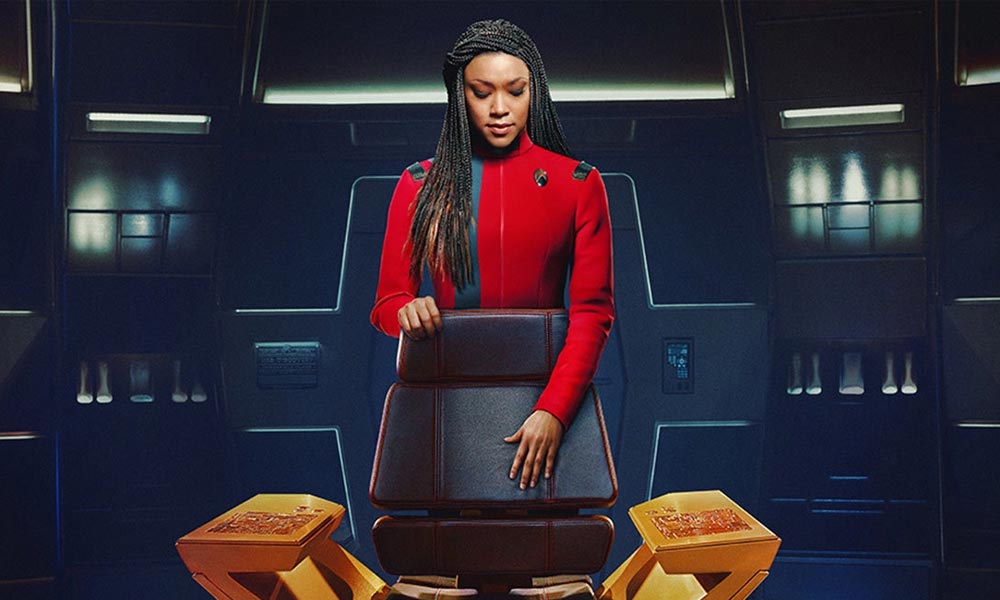
The Science Museum in London has officially opened the doors its Star Trek Warp Trail following last night’s incredible Star Trek Lates event.
Featuring iconic objects from the franchise’s archives and curated by the Science Museum, the free trail explores the surprising connections between science fiction and real-world innovations as it takes visitors on a journey across galleries throughout the museum.
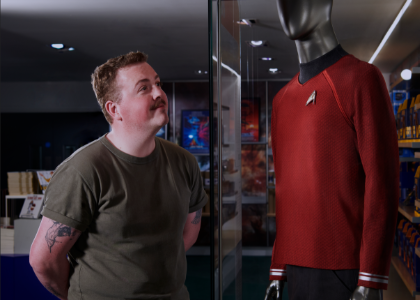
On display will be the uniform belonging to Chief Engineer Montgomery Scott, or Scotty, as played by Simon Pegg in Star Trek (2009); the Command uniform worn by U.S.S. Enterprise Captain Christopher Pike, worn by Anson Mount in Star Trek: Strange New Worlds (2022–); and Admiral Jean-Luc Picard’s uniform, worn by Sir Patrick Stewart in Star Trek: Picard (2020-2023). An EV suit worn by Captain Michael Burnham, as played by Sonequa Martin-Green in Star Trek: Discovery (2017-2024) took inspiration from real spacesuits that hold crucial life support systems to help the wearers survive the vacuum of space.

A model of the U.S.S. Enterprise from Star Trek: Strange New Worlds will greet visitors on their voyage across the museum as lights inside bring the model to life. The Enterprise crew aim to ‘seek out new life and new civilisations, to boldly go where no one has gone before’. The iconic rapidly multiplying tribbles will take up residence as an example of what we might just encounter beyond our solar system.
A striking prop head used in Star Trek: Nemesis (2002) will draw out questions around artificial intelligence. The head is from the prototype android B-4 discovered by Lieutenant Commander Data, played by Brent Spiner, who later merged their programming together. Features that were once a novelty in Star Trek – talking to a starship computer to get information from it – are now daily occurrences for many through AI assistants.
When mobile phones first appeared in the 1970s, Star Trek had already made people familiar with the idea of portable communicators. In fact, when Motorola unveiled its first clamshell flip phone in 1996, the design influence of Star Trek was clear in both its appearance and name: StarTAC. Personal access display devices (PADDs), communicators and combadges from throughout the franchise – including Star Trek: The Original Series; Star Trek: Enterprise and Star Trek: Deep Space Nine – will introduce the key role communication technology and translation play.
Through the costume worn by the fictional inventor of the warp drive: Zefram Cochrane, played by James Cromwell in Star Trek: First Contact, the trail explores how we might travel across vast distances. Interstellar flight is routine in Star Trek, but as a species we have only just begun that journey. NASA spacecraft Voyagers 1 and 2 were launched in 1977 and only entered interstellar space in 2012 and 2018. A photon collector used in Star Trek IV: The Voyage Home (1986) and a spore cannister used in Star Trek: Discovery (2017-2024) invite discussions around powering ships for deep space exploration.
Also on display will be equipment used by doctors on Star Trek such as tricorders to scan patients and hyposprays which administer drugs without needles. Through these, visitors can discover how these imagined instruments have inspired real medical tools, from hand-held scanners which monitor vital signs to needle-free injectors. Future medical technology inspired by Star Trek could include 3D-printed organs, or better versions of brain–computer interfaces that already allow patients to control robotic limbs.

The trail is part of the Science Museum’s programme to mark 60 years of Star Trek. The trail will end in the Star Trek takeover of the mezzanine level of the museum’s shop, where visitors will be able to take the helm and take a picture in a replica of the captain’s chair from Star Trek: Discovery and discover exclusive products created for the anniversary, including a limited-edition anniversary coin and apparel.
