

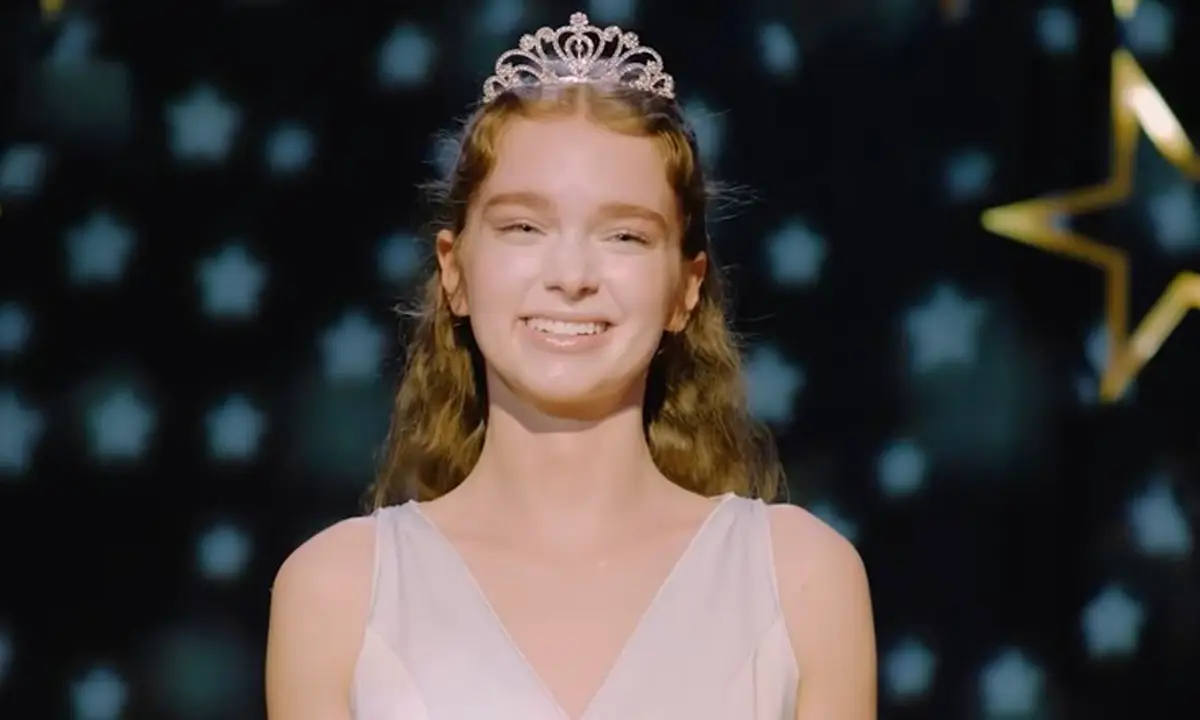
All episodes of Carrie will be able to watch exclusively on Prime Video from October 7, 2026.
Synopsis
Carrie, directed by Mike Flanagan, is adapted from Stephen King’s 1974 debut novel. The eight-part series begins with Carrie (played by Summer H. Howell) losing her father, sending her whole life into a trajectory. After being kept inside all her life by her mother Margaret White (Samantha Sloyan), Carrie is now forced to attend school. Her unusual ways make her the target for Sue Snell (Siena Agudong) and Chris Hargensen (Alison Thornton). But, when a malicious social media account goes viral, the school and Carrie suffer immense consequences – and, as Carrie discovers untapped powers, the results are irreparable.
Review
Carrie’s life begins and ends with the question: “What happens when a troubled girl is pushed too far?” And, Mike Flanagan’s decision to adapt her story begins and ends with a similar, simple question – “Why?”
Viewers will be all too familiar with her story, as it has been revisited and repackaged many a time. Throughout the years, viewers have been invited to step into that fateful prom night and bear witness to the glitz and the glamour, the death and the damnation. With each downpour of blood, Carrie has been reborn over and over, a symbol of feminine trauma and strength; she has been a victim, a villain, a martyr, a saint. So, one has to beg the question: why? Why must we imbue her with such distress once again? And Flanagan’s answer to this is simple, yet powerful – the world is becoming crueller every day, and Carrie’s story can teach us to be kind.
Having previously adapted Gerald’s Game (2017), Doctor Sleep (2019), and The Life of Chuck (2024), it is clear that Flanagan is an acquaintance to King’s tales. And, by choosing Carrie as his next canvas, he once again commits himself to a binding contract of murky horror. However, the director makes it clear that this series will do far more than unnerve you.
Across the eight chapters of the series, Flanagan expands Carrie’s story, using King’s fingertips as a springboard to dive into untapped stories and nuance. The first half unfolds as a story of identity; it froths like a teen flick should as Carrie navigates bullies, hormones, parties and independence. But, the second half blushes a murky crimson, tapping into the beating heart of the book’s true horror – Carrie’s spiralling distress.
Where Sissy Spacek’s 1976 Carrie White was fragile and quiet, newcomer Summer H. Howell draws on the character’s kindness. Carrying herself with an unshakeable core of innocence, Howell introduces Carrie as a gentle, earnest creature. With a somewhat neurodivergent sensibility, she struggles with the ‘rules’ of teen normalcy and often mistakes false kindness for honesty. However, a kernel of repressed emotion slowly grows within her – and when Howell breaks, she breaks with our rising sympathies, and fears.
Despite her original 1970s setting, Carrie is now given a youthful flow of blood in her veins. By placing her in the modern day, Flanagan reimagines King’s world – and it’s colder than the writer could ever have envisioned. Stepping away from her prayer closet, Carrie enters a world where technology is God, and every teen worships with a phone in hand. Instead of the pointing fingers of jeering girls, it is the clinical beam of a torch light that mocks. Homage is given to the original text, with references to other telekinetic women throughout history, being presented in documentary stylings. But, DNA is borrowed from the likes of Mean Girls (2004) and Euphoria (2019-2026) to ground Carrie in a more familiar world. Confronted and confounded by alcohol, edibles, safe sex and periods, Carrie must enter puberty with even fewer guidelines than her 1970s self.
At times, the series retains a down-right love affair with the text; in other moments, it’s a mere flirtation. It is at its weakest, however, when it engages too heavily with its Instagram-filtered update. Glossy with an indie-pop soundtrack and slow-mo hallway shots, the agitated form of Carrie flickers and fades. As the social media scandal unfolds in Ewen High, the intended revulsion is dulled; it becomes a storyline that would feel more at home in a teenage PSA. King’s glorious sense of revenge, of impending tragedy, is instead swapped for a generic, high school fiasco, found in the pages of the Mean Girls’ Burn Book.
Flanagan also opts for a more nuanced look at the characters surround Carrie. Instead of perceiving them solely from Carrie’s perspective, we are given unique insights into the lives of her bullies, teachers and her own mother; where King wanted vitriol and revenge-soaked guts, Flanagan offers nuggets of peace and understanding. We witness Matthew Lillard’s struggling Principal Grayle fight for scholastic unity, Siena Agudong’s Sue Snell grapple with peer pressure, and Amber Midthunder’s Miss Desjardin bond with her fellow teachers. However, this transplant gives Carrie’s decisions lesser meaning, as her oppressors are now softer than ever.
As a consequence, Margaret White, played with steely resolve by Samantha Sloyan, is almost unrecognisable – and inscrutable. She morphs from Carrie’s personal Satan into a helicopter parent, resorting to live-streaming faculty meetings to get justice for her daughter. Her once tumultuous bond with her adolescent becomes transparent, with Carrie’s innocence affording her little, perilous edge. There are genuine flickering flames of fear, moments where Sloyan’s face is almost carved from ice and could cut like a blade. But, suddenly they are dashed into their scabbard, almost as quickly as they were drawn.
When Flanagan allows it to, Carrie is at its best when it dances on the doorstep of hell. This is done to great effect via the expanded character of victorious bully, Chris Hargensen. Played with delicious venom by Alison Thornton, Chris’ fractured home-life leaks into her morality, with each splinter causing a spiral of apathy and rage. Her character often takes centre stage, working to the show’s advantage as she becomes a foil to Carrie’s sweet naivety. Her companionship with Arthur Conti’s Billy Nolan is comparable to the tragic coupling of Bonnie and Clyde; as they skulk off to his trailer, weaving plans of revenge, it becomes the perfect accompaniment to the story’s chaos.
At the beginning of various episodes, the narrator encourages you to peel the pages of history back and look for the women who fought back. They speak of women’s “hysterical strength,” how they are “defamed by men,” and that “people love to watch a woman fall.” Its commendable that Flanagan seeks to change Carrie’s story to flourish under a more feminist frame; the story alterations see women tear at one another because they are tearing at the world, not just for the sake of it. But, one can’t help but feel that this would’ve been more impactful if he let Carrie free of her high-school cliché shackles.
Verdict
Across the eight episodes, Carrie is reimagined as a sheltered sweetheart, and when she embraces the darkness, wicked sparks fly. But, Flanagan’s frothy deviations from the story’s gushing wounds leaves it without an edge – and with far less of an impact than it could’ve had.
⭐⭐⭐
