

Since the 1930s, the Looney Tunes have rampaged through hundreds of cartoons and across countless generations, yet their cinematic journey has been a rollercoaster of soaring highs and disappointing lows.
This path has proven particularly treacherous whenever the characters attempt to bridge the gap between their hand-drawn reality and our own. With the upcoming release of Coyote vs. Acme—a film that has survived an unprecedented behind-the-scenes legal battle just to reach audiences—it is the perfect moment to look back at the franchise’s legacy of stepping off the animation cels and into the real world.
Space Jam (1996)

When Space Jam hit cinemas in November 1996, it wasn’t exactly greeted as a cinematic masterpiece. Critics at the time were largely baffled by the film’s central plot—a feature-length narrative built around a series of popular Nike “Hare Jordan” commercials. Reviewers often dismissed it as a “corporate synergy” project, a 88-minute advertisement designed more to sell shoes and jerseys than to tell a meaningful story. Even the legendary Chuck Jones, the architect of the Looney Tunes’ golden era, was reportedly heartbroken by the film, feeling that his characters had been stripped of their sharp wit to serve as mere sidekicks to Michael Jordan’s global brand.
Despite the critics lukewarm reception, the movie was a commercial juggernaut, grossing over $250 million and becoming the highest-grossing basketball film of all time for over two decades. While adults in 1996 saw a cynical cash-grab, children of the time saw something entirely different: a blend of their two favourite icons. For a generation growing up in the 90s, Michael Jordan was a living legend, and seeing him share the screen with Bugs Bunny felt like a monumental event. This disconnect between critical appraisal and childhood awe is precisely what fuelled the film’s eventual transition into the cult classic we now know.
Today, Space Jam is viewed through a lens of heavy childhood nostalgia. Its flaws such as Jordan’s hilariously wooden acting, the dated 90s lingo, the jarring RnB music backdropped with the Looney Tunes themselves and the somewhat jarring introduction of Lola Bunny and leaning heavily into the ‘male gaze’ appearance which stood out compared to the rest of the Tune Squad. All of these have become cherished features rather than legitimately failing flaws and fans celebrate the film as a top tier 90s time capsule flick, complete with a multi-platinum soundtrack that arguably outshines the movie itself and a promotional website that has famously remained untouched since its original 1996 design.
It is a movie that knows it’s ridiculous and fully owns it, earning a permanent place in pop culture not because it was “good” by any traditional standards, but because it struck a cord with the young 90’s audience for being a film that’s just entirely focused on fun and not major set ups.
Looney Tunes Back In Action (2003)
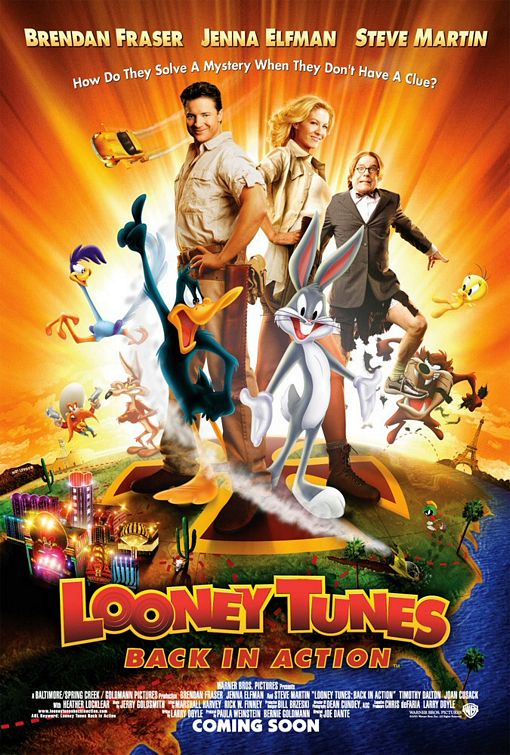
The 2003 follow-up to Space Jam was Looney Tunes: Back in Action. Directed by Joe Dante—a filmmaker who grew up in the classic ‘Tunes’ era and viewed the cartoons as high art the film had aimed to undo what Dante saw as the “corporate sanitization” of Bugs and Daffy. He brought on Eric Goldberg, the legendary animator known for his work on the Genie in Disney’s Aladdin, to ensure the characters moved and acted with the frantic, squash-and-stretch energy of the 1940s era.
The plot was a dizzying meta-commentary on the film industry itself. It began with Daffy Duck being fired from the Warner Brothers lot after a salary dispute and spiralling into to a globe-trotting spy adventure alongside a fired security guard played by Brendan Fraser. Unlike the sports-focused predecessor, Back in Action leaned into surrealist gags, cameos from the likes of Scooby Doo all the way to Daleks and high-concept sequences, such as a chase through the Louvre where the characters changed art styles to match the paintings they entered. It was a movie designed for the hardcore animation buffs who wanted their characters to be chaotic and cartoonish again and logic to be left at the door. Almost existing in the same vein as Who Framed Roger Rabbit, that cartoon characters are actors, living among us in the real world.
However, the production was a notorious battlefield. Dante famously clashed with studio executives who reportedly had “no idea what made the Looney Tunes great,” even questioning why Bugs Bunny wasn’t “doing hip-hop” to stay relevant. The script was rewritten with over 25 uncredited writers, and the tone shifted wildly between Dante’s subversive wit and the studio’s desire for a broad family blockbuster. The final result was a film that critics actually liked more than Space Jam but that audiences almost entirely ignored.
Back in Action became a massive box-office bomb, grossing less than its $80 million budget and effectively killing the Looney Tunes as a theatrical film franchise for nearly two decades. While Space Jam was kept afloat by Michael Jordan’s “living legend” status, Back in Action relied on the Looney Tunes themselves to carry the film but the general public wasn’t as interested. Even with the backing of such big names as Brendan Fraser, Jenna Elfman, Steve Martin and Timothy Dalton it just did not land with people. Whatever audience was there in 1996 had grown beyond the Looney Tunes at this stage and the executives just did not know what they wanted to deliver.
Today, the film is looked back on more favourably by many, noting how the Looney Tunes were more faithful to their core characters in this film than they were in Space Jam, and that corporate meddling throughout was what ruined the film from its possible cult status.
Space Jam: A New Legacy (2021)

Eighteen years after the Looney Tunes Live Action films were shelved by the failure of Back in Action, Warner Bros. attempted to recapture the lightning-in-a-bottle commercial success of the 1996 classic Space Jam with a follow up called, Space Jam: A New Legacy.
Warner Bros. actually has a huge history of trying to follow up Space Jam, even as early as 1997 with bringing Michael Jordan back and re-joining the Tune Squad with taking on another basketball competition, however Jordan never agreed to return and the producer had lied to the studio that he had, so without Jordan, Warner Bros. was uninterested in the sequel and it was shelved.
They then pivoted with so many different avenues including Spy Jam, starring Jackie Chan, Race Jam starring Jeff Gordon and even a golf focused film with Tiger Woods and even Skate Jam with Tony Hawk was in early production. It was clear they were throwing everything at the wall but nothing was landing until they pivoted to Back in Action.
Fast forward to early 2014 where Warner Bros. officially announced a Space Jam 2 with LeBron James starring. That same month, James was quoted as saying, “I’ve always loved Space Jam. It was one of my favorite movies growing up. If I have the opportunity, it will be great.” Despite this, the production of the film did not begin until 2019 and the final product not releasing until 2021, a full 7 years after it’s original announcement.
The plot follows LeBron and his tech-savvy son, Dom, as they are pulled into the “Serververse”—a digital purgatory controlled by a rogue AI named Al-G Rhythm, played with scenery-chewing joy by Don Cheadle.
The film’s central plot serves as a massive, feature-length tour of the Warner Bros. Discovery library. To assemble the Tune Squad, LeBron and Bugs Bunny travel through various “worlds” representing different franchises under ther WBD banner, from the DC Universe and Game of Thrones to The Matrix and Mad Max: Fury Road. This pivot to the “Serververse” was incredibly polarizing with many critics and older fans viewing it as a hollow exercise in IP synergy bragging. Unlike Back in Action in 2003, which used meta-humour to poke fun at the studio system, A New Legacy often felt like an shallow advertisement for the studio’s back catalog, famously featuring background cameos from adult-oriented characters like Alex from A Clockwork Orange and Pennywise the Clown in a movie aimed specifically at children.
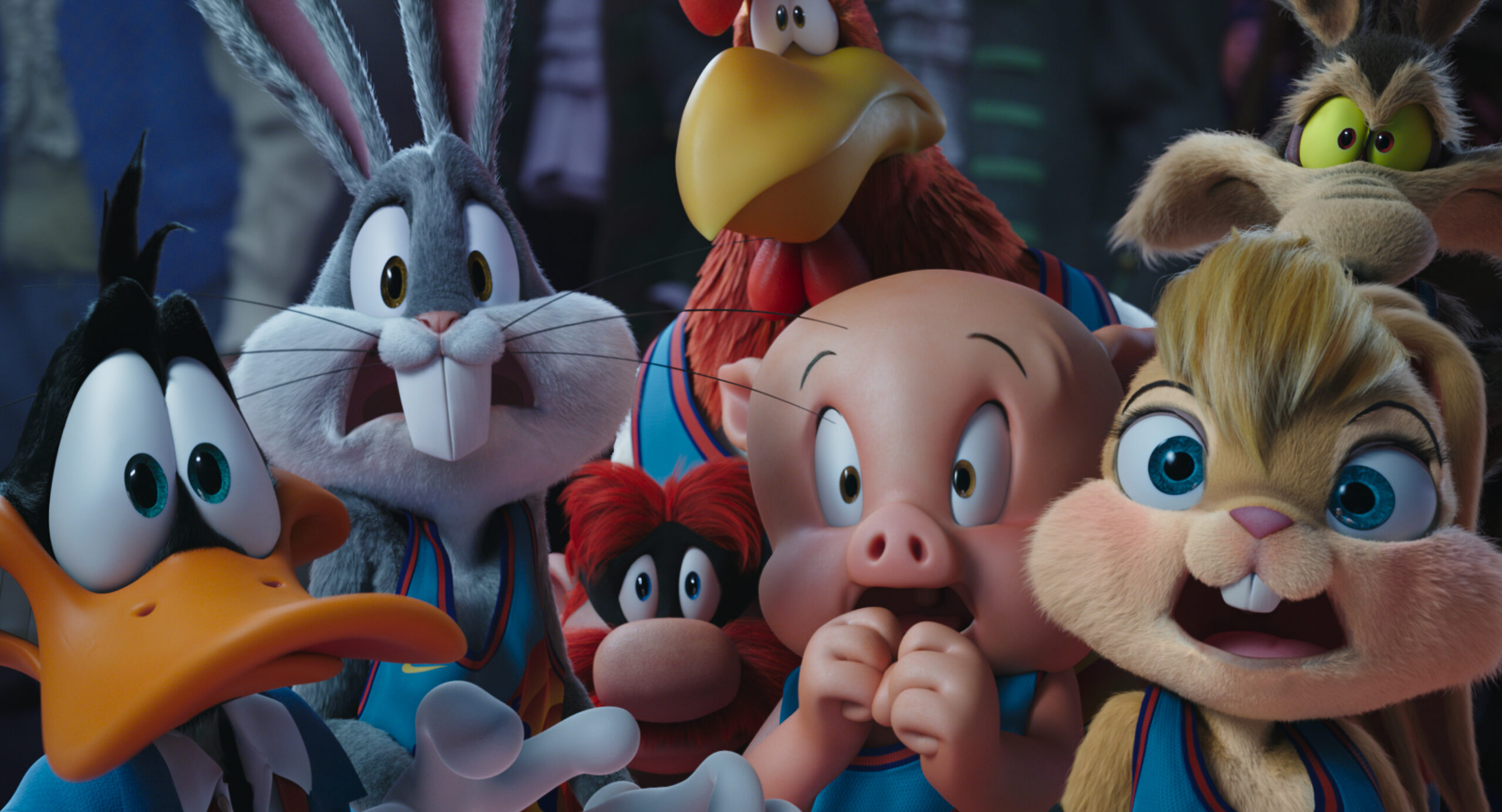
Visually, the film marked a drastic departure from the series’ hand-drawn roots. For the climactic basketball game, classic Basketball was ditched in favour of an inworld set of rules that favoured style points and power-ups over traditional hoops.
The Looney Tunes were upgraded to sleek, CGI models, opting for a more cost effective way to bring them to life as opposed to the traditional animation styles. While the animation quality was technically impressive, old school Looney Tune fans felt it stripped the characters of the “squash-and-stretch” charm that defines them. Despite the backlash from critics regarding its overstuffed runtime and corporate tone, the film performed well on their streaming platform HBO Max, but only making $163.7 million in worldwide ticket sales compared to its $150 million dollar budget.
While nostalgic fans wanted to feel the Space Jam vibe again, forcing it through every other franchise Warner Bros. had ultimately let it down and worked more as an HBO Max advertising than it’s own standard film. Some could say it had effectively transitioned the Looney Tunes from being cartoon characters in their own right to mere digital avatars, setting the stage for the franchise’s most bizarre chapter yet.
Honourable Mention – Who Framed Roger Rabbit (1988)

A small nod to the days long before Space Jam, where the Looney Tunes shared the screen with real life people, they made a historic “guest appearance” in the 1988 Disney classic Who Framed Roger Rabbit. This film remains the only time in cinematic history that the titans of Disney and Warner Bros. shared the big screen, a feat only made possible by the diplomatic manoeuvring of executive producer Steven Spielberg. Because Disney was financing the film, Warner Bros. was notoriously protective of their mascots, fearing that Bugs and Daffy would be relegated to background cameos while Mickey and Donald took the spotlight.
To prevent any perceived “corporate bullying,” Warner Bros. agreed to license their characters only under a set of rigid, legally binding stipulations. The most famous was the “Equal Time” rule: Bugs Bunny could only appear on screen alongside Mickey Mouse, and they had to have the exact same number of frames, the same amount of dialogue, and the same billing. This resulted in the legendary skydiving sequence, where the two icons drop into the frame at precisely the same millisecond to offer Eddie Valiant a spare parachute (which turns out to be a spare tire).
This obsession with parity extended to the “Duck” side of the aisle as well. The film’s duelling piano sequence between Daffy Duck and Donald Duck was governed by the same agreement. Beyond equal screen time, Warner Bros. insisted that Daffy be depicted as just as musically talented as Donald, ensuring that the legendary Rabbit and Duck were never treated as second-class citizens in a Disney-led production. This high-stakes legal dance created a moment of pure movie magic that likely won’t be repeated in our modern era of corporations.
Coyote vs Acme (2026)
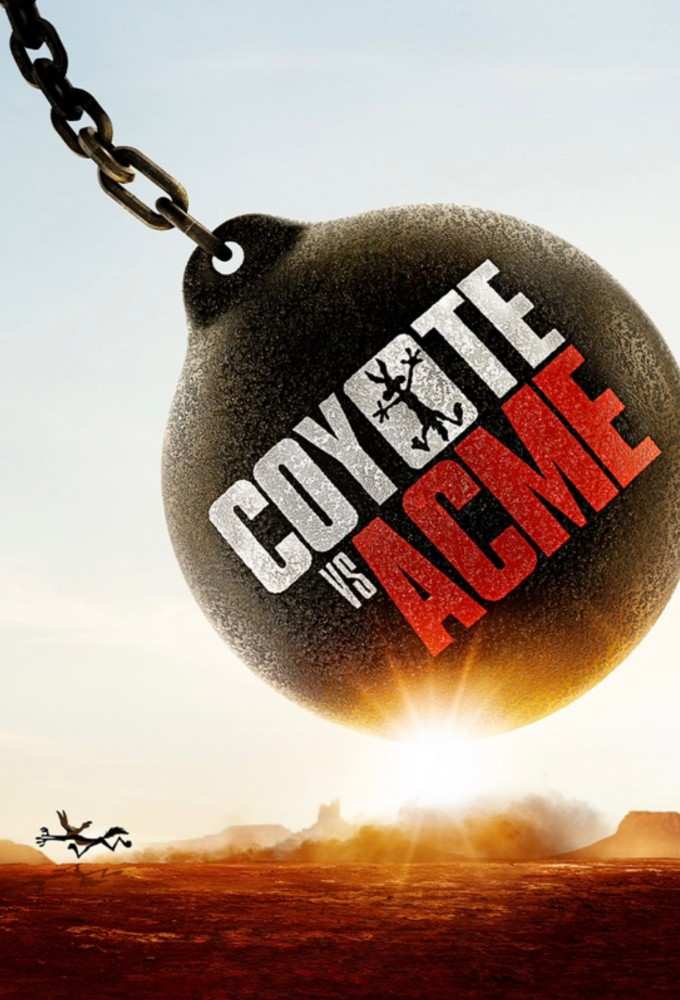
This brings us to the latest attempt, the fabled Coyote Vs Acme film. Originally slated for a 2023 release, Warner Bros. Discovery attempted to “delete” the completed $70 million project as a tax write-off along with the almost finished Batgirl live action movie (a move that shocked the film industry). The decision sparked an huge backlash from creators and fans, turning the film into an example of artistic preservation vs large corporations. After a year of uncertainty, the independent distributor Ketchup Entertainment rescued the film, and now set a worldwide cinema release for the 28th August 2026.
Directed by Dave Green and produced by James Gunn, the film is a legal comedy based on the classic New Yorker humour piece by Ian Frazier. The story follows a down-on-his-luck human attorney, played by Will Forte, who represents Wile E. Coyote in a massive lawsuit against the Acme Corporation. Standing in his way though is the slick, formidable corporate counsel for Acme, played by John Cena.
What makes Coyote vs. Acme so significant is its reported return to classic Looney Tunes form. Early test screenings and the recently released trailer shows a film that reignites the slapstick violence of the original Chuck Jones shorts with a more modern edge. Though the trailer has also given doubt that the finished product was worth the struggle. Many fans noting the 3D Looney Tunes not being as faithful to their original counterparts which has been proven possible to work with the Space Jam film from 1996.
My review for the film can be found here but time will tell whether Coyote vs Acme will perform well in the box office, and if audiences will put their money down after Warner Bros. tried to permanently remove it from the zeitgeist but with the Looney Tunes themselves turning 96 years old in 2026, it does prove they will never truly fade from the public eye, they just might need to find out where they sit.
