

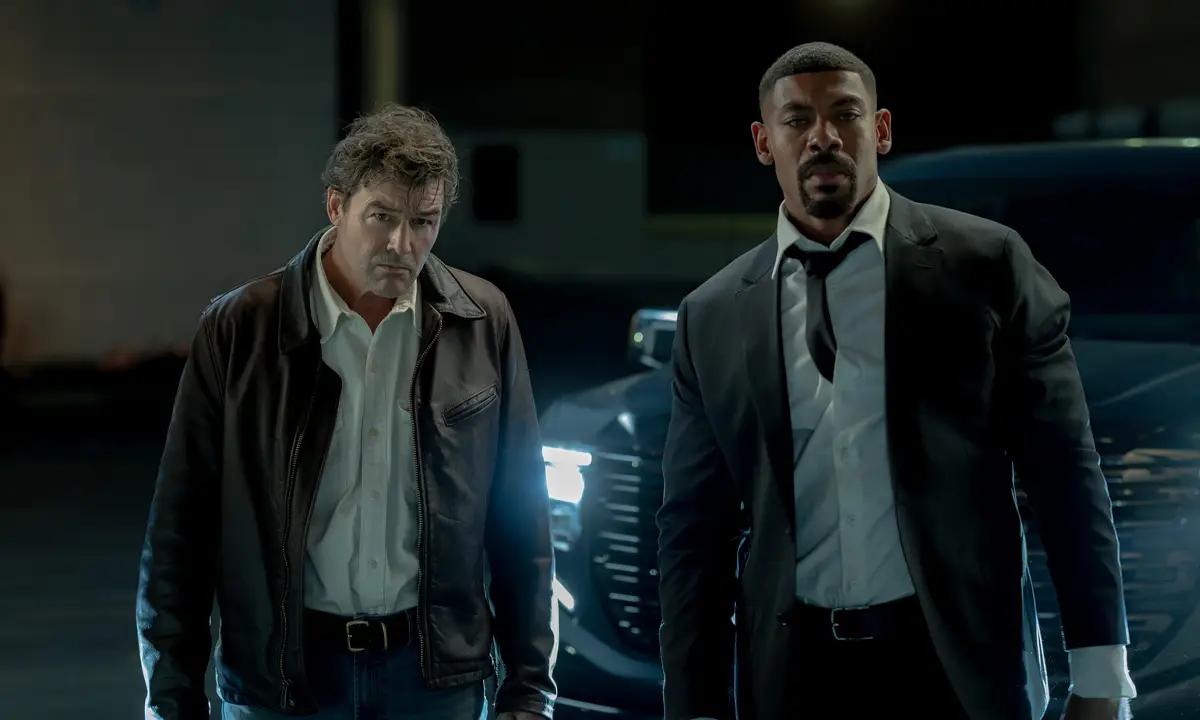
The emotional Lanterns Season 1 finale finally closed off the mystery of Hal’s death, the mysteries of Rushville and helped establish John Stewart’s place in the DCU going forward. In a press conference following the finale, lead stars Kyle Chandler and Aaron Pierre, alongside moderator Mallory Rubin, opened up about the emotional weight of Episode 8, the bond they forged during production, and what makes this DCU series unique.
A Superhero Story Driven by Vulnerability and Connection
While Lanterns features some deep interstellar lore and some Green Lantern Corps action, both actors emphasized that at its core, the season operates as an emotional love story between two radically different men. Pierre noted that while he and Chandler come from completely different backgrounds, filming over 116 long days allowed them to form an immediate bond that directly mirrored John and Hal’s journey on screen.
“I think what it highlights is that our differences and our nuances need not be a point of contention. They can be a point of education. They can be a point of insight. They can be a point of connectivity, connective tissue..”
— Aaron Pierre
That vulnerability carries straight into the finale’s emotional climax. Chandler shared that rewatching the closing moments—where Hal and John exchange an affectionate “I love you”—brought him to tears, comparing the emotional payoff to a major athletic victory.
“It is like, you know, when you win the state championship, tears come to your eye ’cause all the work that you put in slams into you at one moment on the field, and it happened to me this morning watching it, saying goodbye to him and the whole thing and all of it, all of it really did compact in just a little shooting star. And I did have to gently wipe away a tear so my wife didn’t make fun of me. But it was like saying goodbye to a lot of old friends and a lot of great memories and a lot of experiences, you know, temporarily until I think about them again.”
— Kyle Chandler
Chandler, who lost his own father at age 14, also highlighted the father-son bond that forms between Hal and John. “Hal had that going on with John, that father/son relationship,” Chandler explained. “That wisdom and being able to give back a little bit… he won my heart over in the end and I was able to do what my father would have done for me.”
John Stewart’s Origin Story
For Aaron Pierre, playing John Stewart offered a rare opportunity to showcase a hero who isn’t inherently fearless, but rather someone whose true strength comes from acknowledging fear and actively overcoming it. Pierre revealed that his primary acting challenge was portraying the “boy before he becomes the man” across the first four episodes.
“John Stewart really appears from Episode 5 through to 8. That’s John Stewart. Episodes 1 to 4, yes, he’s technically John Stewart, but I had to figure out who the man was before he became the man. You know, John Stewart in 5 to 8 is who we’re going to, over the years, become familiar with and connected with. That’s our John Stewart, you know, whether that’s in the DC Cinematic Universe or whatever it is. But I was like, “Who is the boy before he becomes the man?” and I had to sort of reverse-engineer him. And that was really challenging as a task, because everything in me, when I’m reading Episodes 1 to 4, you know, as a John Stewart fan myself, I’m going, “Ah, John wouldn’t have that.” You know, I’m like, “I don’t think John would let that slide,” you know. But I had to remember that that’s the boy. That’s not the man yet.”
— Aaron Pierre
The series avoids standard superhero stoicism, allowing John’s strength to manifest through quiet conversations, forgiveness, and emotional openness. Pierre emphasised that John’s real superpower is his willingness to be a student.
“John’s superpower, in my opinion, subjectively, is not being fearless. It’s the ability to acknowledge fear and overcome it. And what I hope people catch is that in 1 to 4, he sort of quietly, quite stoically accepts the fact—maybe he doesn’t articulate it to Hal—but he’s like, “Yeah, I’m not ready for the job yet.” But he leans into it so heavily. He doesn’t lean away from it. He doesn’t lean away from it with arrogance or with delusion. He leans into it and actively searches for ways to become everything he knows he can become, if he just makes himself the student that absorbs versus deflecting when he doesn’t know something.”
— Aaron Pierre
Unpacking Hal Jordan, the “Halogram,” and Episode 4’s Pivotal Turn
When asked about scenes that take on a deeper meaning after viewing the finale, Chandler pointed back to a quiet night shoot in Episode 4 where Hal tells John, “I really did trust you.” On a rewatch, this grounded exchange reveals that the seeds of a genuine connection were present early on, even when their mission seemed to be falling apart.
“That moment for me was a different moment in the show, because I made it very real. I really did trust him. And that was kind of a great moment for me to fall back into. You know, it gave me a restart, if you will. So that was a really, really great moment.”
— Kyle Chandler
Chandler also praised the writing team for seamlessly blending Hal’s past in the 2016 timeline with his subconscious “Halogram” presence.
“He could never pluck that string as Hal in the show. But as Halogram, he learned with Hal, and he could pluck the string. That’s how I sort of look at it. Like the two of them were never fully separated, he is his subconscious, so there’s a lot to play with there.”
— Kyle Chandler
Grounded Storytelling and Social Commentary
Lanterns sets itself apart in the superhero landscape by combining real-world themes of identity, inherited trauma, and political division into a grounded detective mystery all wrapped up in a Superhero cape of sorts. Pierre highlighted how the show handles these sensitive subjects as an open invitation to a conversation rather than a heavy-handed lecture.
“Lanterns as a story, Lanterns as a creative team, what they did so beautifully and so masterfully is they create conversation. They create critical conversation, they create necessary conversation, and they give insight. They give insight to a number of perspectives, whether that’s John’s perspective, whether that’s Hal’s perspective, whether that’s John’s life experience, whether that’s Hal’s life experience. They give insight into a particular experience. And I think that does two things at the same time. It allows people whose experience that is, they feel seen, they feel heard, they feel understood, they feel respected. And to those whose experience it isn’t, it gives a number of beautiful access points to be able to empathise with it”
— Aaron Pierre
Both actors credited the collaborative environment built by the creative team, emphasizing how essential selflessness was during production.
“This series categorically does not work if I as the actor or Kyle as the actor or any of us as actors make it about ourselves in the scene. Everything had to be about the other person. Otherwise, the whole thing just collapses in on itself, like a cake that you take out of the oven too early. It just, like—you know what I mean? It was like every time we were in a scene for these 116 days, you know, it was like, yes, do your work, you know, make your notes. You know, both Kyle and I, we, you know, we’re kind of obsessive with, like, the minutiae of things. So, of course, we do unnecessary homework and make notes and come prepared, obviously, you know. But as soon as all of that’s done and that’s sort of absorbed by osmosis or what have you, like, then everything—as far as I was concerned—everything had to be about Kyle. And then for Kyle, everything had to be about me, or whoever we were in the scene with, Kelly or Nathan. And all of a sudden, it becomes so much more interesting, because it’s not inwardly focused.”
— Aaron Pierre
Chandler summed up the entire experience in a single word: trust.
“I mean, when a performer can go—when I can go, an actor, what have you—when a performer into a piece with trust, he can do anything, and he can give 110 percent because he’s got that trust. And that’s what they imbued us with, trust, kindness, respect, and respect, and the respect that they had for the actors. Forget about actors, the respect they have for people, as people. And I experienced this in a few different ways that were very important to me, and they are really—that’s it. They imbued that trust and that kindness and that love and that compassion and their intelligence. And, you know, as my dad used to say, they’re good people.”
— Kyle Chandler
What Would the Stars Do with a Green Lantern Ring?
To wrap up the press conference, both actors shared what construct they would manifest if given a Power Ring for 24 hours. Chandler pitched a classic Twilight Zone-style construct aimed at correcting bad behaviour.
“I’d make a construct—I think it was an old Twilight Zone where the sun never came up when people had bad thoughts in their minds. And so I’d make a construct where everyone who is out to do bad and not being part of the human community, the human experience, but veering too far off for themselves or towards places they shouldn’t be, would either sort of fade away in a transparency, so you could barely see them, like Wonder Woman and her jet flying around when we were kids in the cartoon, and/or their words were taken away from them. They were mute. They had no way to express themselves until they were able to be intellectually, I mean, not proper, but intellectually worthy to use words, to speak and to make actions.”
— Kyle Chandler
Pierre laughed off the challenge of following Chandler’s answer, admitting that having full imagination with a ring felt like standing in front of an endless buffet. Instead, he deferred to Chandler’s inventive reality, bringing a warm close to an emotional reflection on their time in the Green Lantern Corps.
Stream all episodes of Lanterns now on HBO Max globally.
