

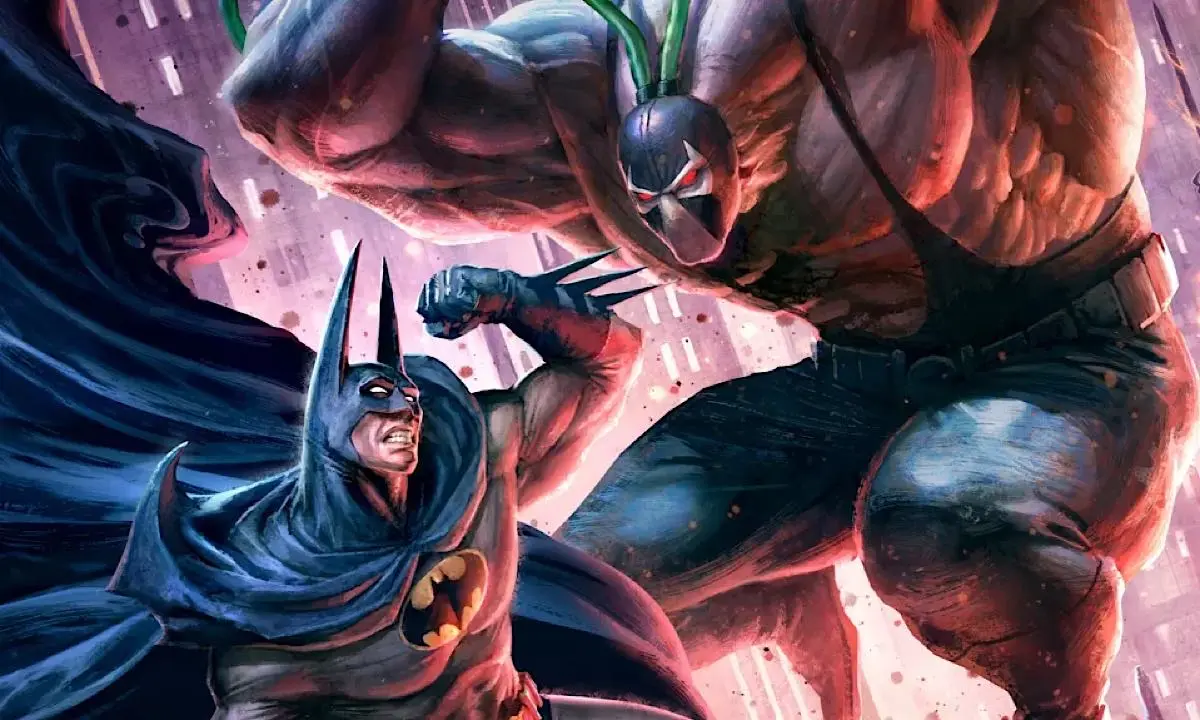
Warner Bros. Home Entertainment debuts Batman: Knightfall Part One on digital platforms on August 25, 2026 and on 4K UHD, Blu-ray and DVD on September 8, 2026.
Synopsis
Arkham Asylum has been destroyed, and all its inmates have been unleashed upon Gotham City. As Batman races to round up some of his greatest enemies, he is pushed to his physical and mental limits and into a final confrontation with a new threat: the man called Bane.
Review
In the pantheon of superhero comics there are a handful of iconic images that have proliferated into the public conscious. For DC Comics, one of those images is undoubtedly the shocking image of a hulking Bane shattering Batman’s spine across his knee – brought even further into the public conscious by Christopher Nolan in The Dark Knight Rises. This week that image is being brought to life in animation with the digital debut of Jeff Wamester’s latest DC-directorial effort, Batman: Knightfall Part One.
The original Batman: Knightfall comic book run spanned 12 months and multiple writers including Chuck Dixon, Doug Moench, Alan Grant, with additional contributions from Dennis O’Neil and Jo Duffy, with the complete saga clocking in at 2,832 pages across three volumes. Adapting that into three animated films was always going to result in changes, which is why Wamester and long-time DC animation producers Jim Krieg and Kimberley S. Moreau turned to fellow DC veteran Jeremy Adams to pen the screenplay. Part One alone, despite running just 78 minutes, only gets through around 350 pages of the 634-page first volume.
The good news is that the essence of what that incredible team of writers created back in 1993 is completely intact, which, as a lifelong comic book fan, is reassuring. The smartest change Adams makes is a genuine structural choice, Batman (Anson Mount) and Bane (Michael Mando) don’t actually meet until the climactic battle at Wayne Manor. In the book, the two face off much earlier, with Bane stalking the Dark Knight throughout the story. Here, keeping them apart lets Bane’s threat to the city escalate while Batman is worn down in growing isolation, so that by the time the two are finally staring each other down, Bruce is completely bewildered. That moment also arrives right where he might have reconciled with Tim (Jack Griffo) and Alfred (Simon Templeman).
Delaying that confrontation only works because the film does the harder job first: making Bane a credible, terrifying threat in a fraction of the comic’s duration. Adams’ screenplay opens with a bait-and-switch, a scene that looks like Batman breaking up a people-smuggling gang before revealing something far more gruesome, introducing Azrael (Pablo Schreiber), a character non-comic readers will know far less than Bane, despite his Arkham Asylum games appearances which never quite broke him into the mainstream. From there, events shift to Santa Prisca for Bane’s birth, and Adams sticks close to the source, changing only small details in order to give more context to Bane’s fixation with the Bat, baking that adversarial relationship into his DNA from the start. His harsh upbringing is otherwise left intact, with some scenes genuinely difficult to stomach. Adams toes a fine line here: setting Bane up as a devastating threat without ever making him someone the audience sympathises with, so that when the fully-formed, masked menace arrives in Gotham, it’s purely to cause chaos, with no hope of redemption.
Both the comic and the film use Bane’s attack on Arkham as the inciting incident for what follows. Where the book spins that into a series of issues each starring a different villain, the film narrows its focus to just a few – Mad Hatter (Jason Flemyng), Zsasz (Andrew Morgado), and Riddler (David Dastmalchian) – while folding others into a montage that does real work illustrating the nightly repetition wearing Batman down. Adams uses the extended villain sequences specifically to chart Bruce’s unravelling state of mind: with Zsasz, he can barely hold back his rage; with Hatter, he’s incapable of registering that Tim saved the day; with Riddler, it’s the first time he underestimates what Bane is truly capable of. By the time Bane and Batman finally meet, the film has already shown us a Dark Knight who’s mentally broken before he’s ever physically broken.
There’s something about seeing Batman so dedicated to cleaning up the mess in Gotham that he can’t see the bigger problem unfolding in front of his very eyes. It feels inherently Batman, particularly of the era Knightfall hails from and in no small part due to the loss of Jason Todd. Though that death played out in 1988, 5 years before Knightfall, in the timeline it’s recent enough to still be an open wound for Bruce. The influence this story had on Christopher Nolan is apparent throughout and equally as refreshing to see over the traditional World’s Finest Detective approach to the character.
The supporting cast of Knightfall are all well captured within its story. Fans of Tim Drake in particular have a lot to be excited about as this is one of his best appearances on film. Visually the costume is perfect and insanely vivid against the dreary nighttime landscape. But his character voice is spot on for early years Tim with his role in the story being enhanced by Adams’ changes. With Batman no longer meeting Bane early in the story it’s a fight between Tim and the villain, which also featured Killer Croc in the comic but not here, which acts are our first chance to see one of the dynamic duo outmanoeuvred. The scene itself is extremely tense and easily a highlight of all the action sets pieces in Part One.
The style of Batman: Knightfall Part One feels like a conscious step forwards for DC. Having moved on from the aesthetic of the Tomorrow-verse era of films the studio has embraced something more traditional in design but contemporary in execution. Taking cues from the group of artists who were working on Batman and his associated titles in 1993, Knightfall feels not a million miles away from the 1997 Spawn animated series. With the majority of the film taking place at night means that Gotham is very murky. Buildings are tall and oppressive but so is the smog in the air, meaning the city takes on an earthy brown hue at times. Meanwhile costumed characters stand out in stark contrast. The inky blue of Batman’s cape and its highlights appear as though they’ve been ripped directly from the page of a comic book itself. This Batman might feature the traditional yellow oval and an uncomplicated utility but his spiked shoulders, an incredible callback to the era of 90s comics, make this a unique take on the costume which fans have been crying out to see.
Part One is absolutely Bruce’s movie and rightly so. It neatly puts all the pieces in place for parts two and three, but does so without losing focus on Batman’s predicament. His ruthless determination is front and centre until the moment Bane shatters the illusion of control. Jean-Paul Valley sits in the background throughout all of this having really only cameoed at certain points in a way which sets him up to take the lead in Part Two. Now it’ll be interesting to see how the team fleshes out his character and presents his version of Batman to the audience.
Verdict
Batman: Knightfall Part One had a seemingly insurmountable task ahead of it, condensing 2,832 pages of one of the Dark Knight’s defining sagas into a trilogy without losing what made it work. Jeremy Adams and Jeff Wamester pull it off by trusting the changes that matter and being faithful where it counts. Two years after Crisis on Infinite Earths Part Three, DC returns with one of its most confident animated movies in years.
⭐⭐⭐⭐⭐
