

A24 releases You Can See Everything in UK cinemas on November 20, 2026.
Synopsis
Thirty-four days before she’s sent to prison, notorious Silicon Valley founder Elizabeth Holmes invites a skeptical film crew to document her every move. What begins as an intimate portrait of an enigmatic felon becomes a mind-bending three year journey into the abyss. From boundary-pushing directors Nathan Fielder and Lance Oppenheim comes YOU CAN SEE EVERYTHING.
Review
Going into the cinema, I was highly anticipating You Can See Everything. Louis Theroux, Jon Ronson, Nick Broomfield, and Adam Curtis documentaries are as commonly enjoyed in my house as Spielberg, Nolan or any other cinematic auteurs of fiction. I hadn’t anticipated adding deadpan comedian Nathan Fielder to that elite list of documentarians.
I was a fan of Nathan for You when it first aired, appreciating how Fielder subverted social norms and situations, disarming people dryly and showing unbreakable resolve in moments that most people would find excruciatingly uncomfortable. It often cut to the core of unspoken truths and unveiled surprises in a way that I just can’t imagine any other method would.
With You Can See Everything, I was anticipating a combination of Fielder’s method and the unrelenting tension and pace of Oppenheim’s 2026 film Primetime, or to keep it within the realm of Lance Oppenheim’s documentary work with the kind of intentionally uncomfortable and close-quarters focus that I enjoyed in the 2024 documentary Ren Faire. What we got was a three-hour psychological test that blended the absolute best of both’s work, creating something completely unique in the process that asked deep questions not only of the film’s subjects, but the filmmakers and uniquely, the audience itself too.
Fielder’s presence turns what was a seemingly straightforward participatory documentary into a unique 3-year-long meta-experiment. You Can See Everything is not a portrait of a disgraced Silicon Valley visionary, as much as it’s an absolute masterclass in manipulation, plausible deniability, weaponised incompetence and how ‘truth’ is constructed. Fielder’s work in comedy may incorrectly give the impression to some that everything he is doing is for laughs, and there were copious laughs early in the film. Fielder’s hawkish scepticism and dry cynical artifice coming face-to-face with Elizabeth Holmes’s seemingly delusional and unsettling level of self-confident deceit felt like two master swordsmen duelling.
It soon becomes apparent that maybe all is not as it seems and that Holmes is not the singular player in this farce. Enter Billy Evans, Elizabeth Holmes’s boyfriend. Billy is combative, confident, charismatic and portrayed as a complete and utter control freak. Uncompromisingly awful, vain, hiding in plain sight. If there is one person in this film that I know how I feel about, it is him. A tragic, MAGA minion, devoid of empathy or self awareness. Tensions in the triangulation of Elizabeth, Billy and Nathan are palpable and as the proverbial pot boils slowly across the film, we are treated to a number of revelations, twists, turns and dynamic shifts that take the story of this documentary into an almost “buddy cop” style detective mystery, between two incredibly unlikely but compelling partners.
Oppenheim and Fielder deserve so much credit for the way this film never stops delivering. It’s a nearly three-hour documentary, yet it does not relent in pace or plot. Instead it transforms and evolves, taking multiple surrealist tangents that intensify as the film progresses and potential clarity wanes in the minds of audience, all without ever losing sight of the film’s seeming subject, Elizabeth Holmes.
Something that really toyed with me was how there are several unscripted scenes so feverishly packed with drama, that you would be forgiven for questioning their legitimacy. Multiple moments of real-time reaction that could be mistaken for Academy Award-level acting, playing out plotlines that if scripted for a piece of fiction may well be turned away, due to the lack of believability. On the flip side of that, there are also reenactments that so perfectly nail the tone and characterisation of our seeming antagonists, that you’re left wondering if things are as they seem, or if you’re just subconsciously applying your own confirmation bias and preconceptions onto the “real” Elizabeth Holmes.
Fielder and Oppenheim subtly pose rhetorical questions and subvert expectations regularly in a way that encourages introspection for the audience. It can leave you tied in knots, trying to figure out the difference between the top and bottom, but this isn’t a “whodunnit”, I believe you could watch it 5,000 times and still struggle to find an objective truth in several of the film’s key focuses and moments.
Ari Balouzian’s atmospheric ambient electronic soundtrack, punctuated by bleeding strings and electronics really lends itself to the fever dream atmosphere that this film brews. Melancholic and anxiety-driving at times, it often leaves space in a way that mirrors Nathan Fielder’s method and style, but moments of real tension hit a Hitchcockian vibe, striking real fear in a jarring and uncomfortable manner at points, that only serves to underline the very subtle social-situational horrors happening before our very eyes.
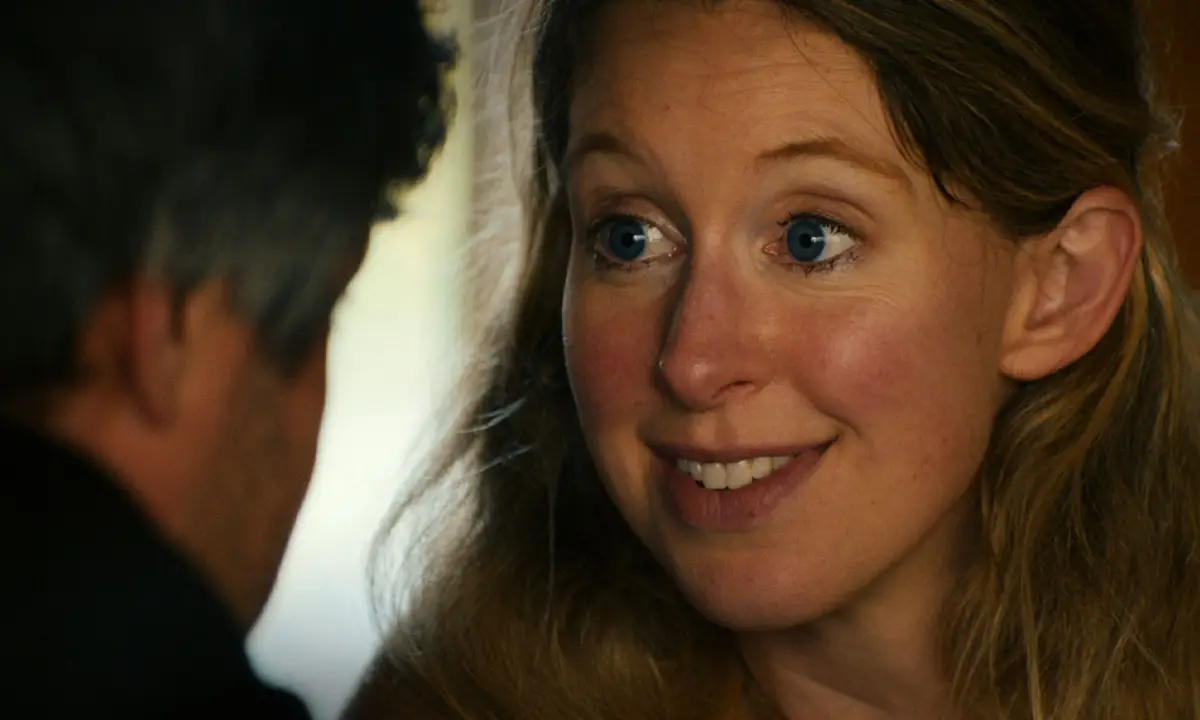
As the title suggests You Can See Everything is deeply voyeuristic, intrusive and often claustrophobic, with extreme close-ups that lead to conversations often feeling more like an interrogation than intimacy. I was surprised at just how vibrant the cinematography was, there’s a vintage feel to the colouration and the beauty of the shots of the environments often offers an interesting juxtaposition to the ugly behaviour on display.
As the film reached its conclusion I found myself more easily emotional and overwhelmed by seemingly simple moments. This perhaps was by design, in an effort to replicate something akin to the confusion felt by various people in various moments of the film itself? Purposeful or not, it was visceral, so often seemingly logical thought was challenged in a way that highlights your own potential bias, ignorance or hypocrisy and you start to wonder if the version of ‘truth’ you are constructing holds any validity, or if it’s just as potentially flawed as that of anyone featuring in the production…
Are you on to something, or are you allowing yourself to be seduced?
Verdict
You Can See Everything lives with you long after you leave the cinema. It’s both haunting and hilarious. With an unyielding proximity this film investigates deceit, charm, the very nature of performance and its relationship to truth, in a way I have never seen done before.
⭐⭐⭐⭐⭐
