

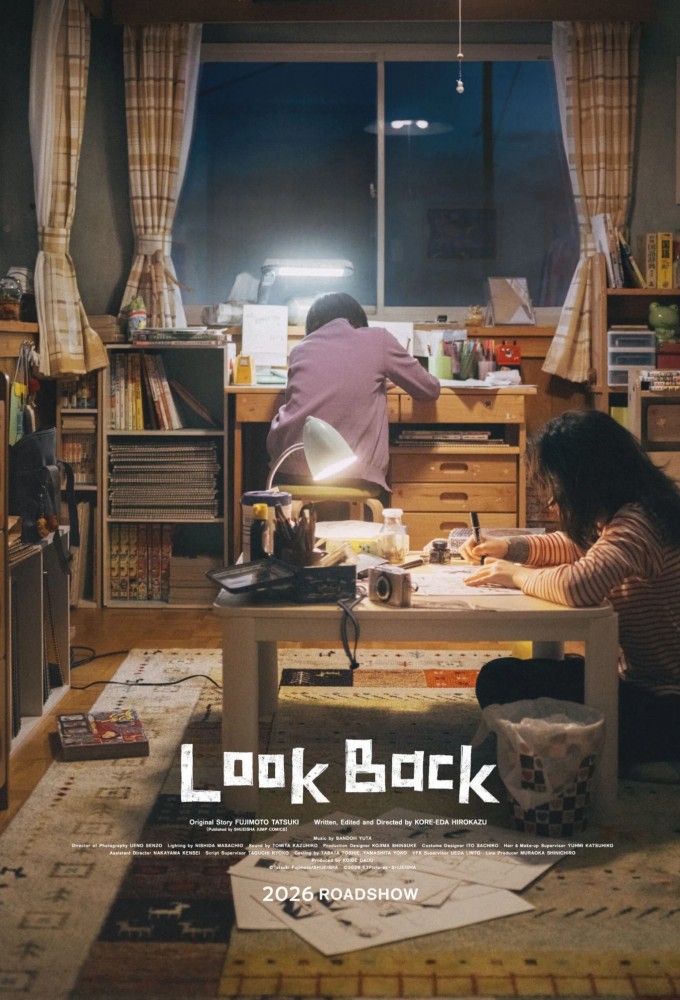
Anime Limited will release Look Back in cinemas across the UK and Ireland in 2027.
Synopsis
Aspiring manga artist Fujino meets Kymoto, a shy admirer of her work. Seemingly opposites, they create the perfect team with their shared love of the form. But as their work draws praise and attention, they find themselves confronted with decisions that threaten their artistic collaboration. Koreeda’s stiking love letter to friendship and the creative process offers keen insight into the craft.
Review
It is nothing short of extraordinary how every single version of Tatsuki Fujimoto’s masterpiece—from the original manga to the anime adaptation, and now this breath-taking live-action adaptation—manages to preserve the exact same beat, rhythm, and soul of the source material. Translating Fujimoto’s distinct, deeply personal style into live-action is no easy feat, yet this film does so with an unbelievable amount of polish and care.
Going into this screening as someone who had already read the manga and experienced the anime, I fully knew what emotional beats were coming. I knew the turns, the layout of the rooms, and the weight of what lay ahead. Yet, even with that knowledge, the story hit every single nerve as if I were experiencing it for the first very time. Look Back remains a poignant, devastating reminder of what it truly means to chase a dream, to pour yourself into something larger than your current expectations, and to find another rare soul who shares in that same internal fire—a presence that lets your own flame burn so much brighter.

At its core, this narrative is a love letter and a salute to anyone who carries the heart of a storyteller deep inside them. It completely rejects the Hollywood trope of the quick, triumphant montage where mastery is achieved in a few minutes. Instead, it respects the artist enough to depict the reality of the grind: the sheer, agonizing volume of trial and error, the unglamorous isolation from your peers, the aching setbacks, and the countless hours spent staring at blank pages. It captures the terrifying vulnerability of creating something, putting it out into the world, and hoping it connects with others.
And when the story takes its pivotal, devastating turn, it doesn’t lean into melodrama or cheap theatricality. It breaks your heart in the most hauntingly human, beautiful way imaginable.
Much of what makes this live-action adaptation resonate on such a profound level comes down to its distinct cinematic language—a masterclass in the restraint characteristic of Japanese storytelling. Where Western cinema so often relies on sweeping orchestral scores to instruct the audience on how to feel in any given frame, Look Back trusts its viewers enough to lean into silence.

The sound design here is extraordinary in its subtlety. When Fujino and Kyomoto are working, the audio landscape is stripped down to its absolute essentials: nothing but the rhythmic, solitary scratch of a pen dragging across paper, the rustle of papers, and the heavy quietness of a room where hours pass in a blink of an eye. When they step outside, the film opens up to the pure, unvarnished sounds of nature—the wind through the trees, distant rain, footsteps in snow. And in its heaviest, most agonizing moments, the film doesn’t rush to fill the void. It holds the silence. It forces you to sit in the stillness alongside the characters, granting us the painful, silent space to process the weight of what has just occurred and how they are feeling.

Verdict
Regardless of which medium you choose to enter this story through—whether you flip through the manga panels, watch the anime adaptation, or sit in the dark for this live-action film—you are promised a truly unforgettable experience. Look Back is a triumphant, deeply moving testament to friendship, art, and the ghosts of the paths not taken. An absolute masterpiece through and through.
⭐⭐⭐⭐⭐
