


How much is Frodo Baggins’ life insurance premium?1
What is the half-life of the Incredible Hulk?2
How long would it actually take to ‘catch ’em all’?3
How strong is Captain America, really?4
These are just some of the questions Oxford mathematician and self-confessed nerd Dr Tom Crawford sets out to answer in his brilliantly entertaining new book, How Many Pikachus Would it Take to Power a Lightbulb (19 November, Hutchinson Heinemann).
Delving into the fantasy worlds of Pokémon, Harry Potter, Lord of the Rings, Star Wars, Marvel and more, Tom answers all of the most bamboozling maths questions possible: from calculating Frodo Baggins’ life insurance premium for his journey to Mordor, to what it would take to make the Weasley family car fly, to how rich Super Mario would be after he’d gobbled up all those coins. The result is both a dizzying compendium of fantastical ‘did you know?’ facts and a guide to the mathematics of life, the universe and everything.
This book draws on over a decade of Tom’s own research at some of the world’s leading universities. He is a maths fellow at theUniversity of Oxford, holds a PhD in Fluid Dynamics from the University of Cambridge, and is the creator of the popular Tom Rocks Maths YouTube channel. He regularly appears on the BBC making maths accessible to a mainstream audience and has also stood in for Rachel Riley on Countdown.
The book isn’t just for mathematicians, it’s for anyone interested in pop culture and fandom, fantasy worlds, science, trivia and more. . .even I, who am truly terrible at maths found it fun, insightful and hilarious.
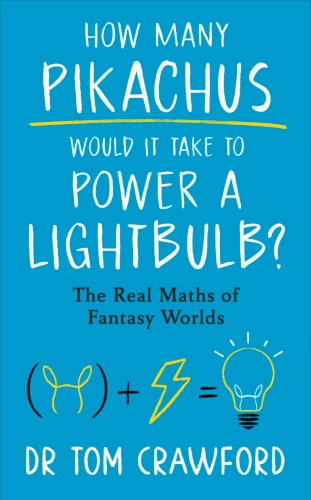
This exciting and insighful new book will hit the shelves on November 19th- that’s going straight onto the Christmas list- so you don’t have to be a mathmatician or a scientist, your love of all things popular culture will make this book a thrilling and fun read, guaranteed. While we’re here, let’s take a look at those answers…
Answers:
1 During his journey to destroy the One Ring at Mordor, Frodo Baggins accumulates approximately 2,491,558 micromorts – indicating that, statistically speaking, he should die at least 2.5 times. This means he is technically uninsurable. If a company were to insure him anyway, it would cost him about £1,560,500 per month (significantly more than would be paid out upon his death).
2 The Hulk would lose the first 50% of his radioactivity in about six minutes; and the next 50% in about 12.35 years. Having been created in 1962, this would indicate that the Hulk has been at critical levels of radioactive decay since 2011. As of 2026, he seems unlikely to be dangerously radioactive, and definitely not radioactive enough to glow green.
3 Based on the size of the Pallet Town map as depicted in Pokémon Red, the average walking speed, and the average time to hook a fish, it would take 1,822 days (about five years) just to catch all of Generation I. Multiplying this by 9 for the 9 Generations, and you have 45 years. ‘Catching ’em all’ is a literal life’s work.
4 Captain America’s success lies in his almost superhuman athletic ability, which upon his creation in 1943 was described as ‘beyond Olympic level’. If we assume that this indicates he is about 1 standard deviation better than the top athletes of the mid 1940s, this would indicate he is marginally slower than Usain Bolt, and significantly less strong than almost all current Olympic weightlifters.
For more book news, click here.
