

To celebrate the release of Mamoru Hosoda’s latest hit Scarlet, which is hitting the big screen on March 13th, we had the very special opportunity of talking to Hosoda about his latest feature. Mamoru Hosoda has crafted some of the biggest and best anime features, including Wolf Children, Summer Wars, Mirai and more recently Belle. Covering a wide range of topics, themes and visual aesthetics, Hosoda is an incredibly versatile director and animator who has a keen eye for detail and the bizarre. From virtual reality romances, time travelling teenagers, to beastly kingdoms, every film from Hosoda is a guarenteed treat.
In our discussion with Hosoda, we focused primarily on the production of Scarlet. The film itself features untraditional forms of animation, as well as obvious sources of inspiration which Hosoda used to structure his latest film. As huge fans of Hosoda, it was incredibly special to be able to learn more about his process and what drove him to produce a film as ambitious as this.

I read that Scarlet took a few years to develop because of the animation style. As a creator, how important was it for you to move away from traditional 2D animation?
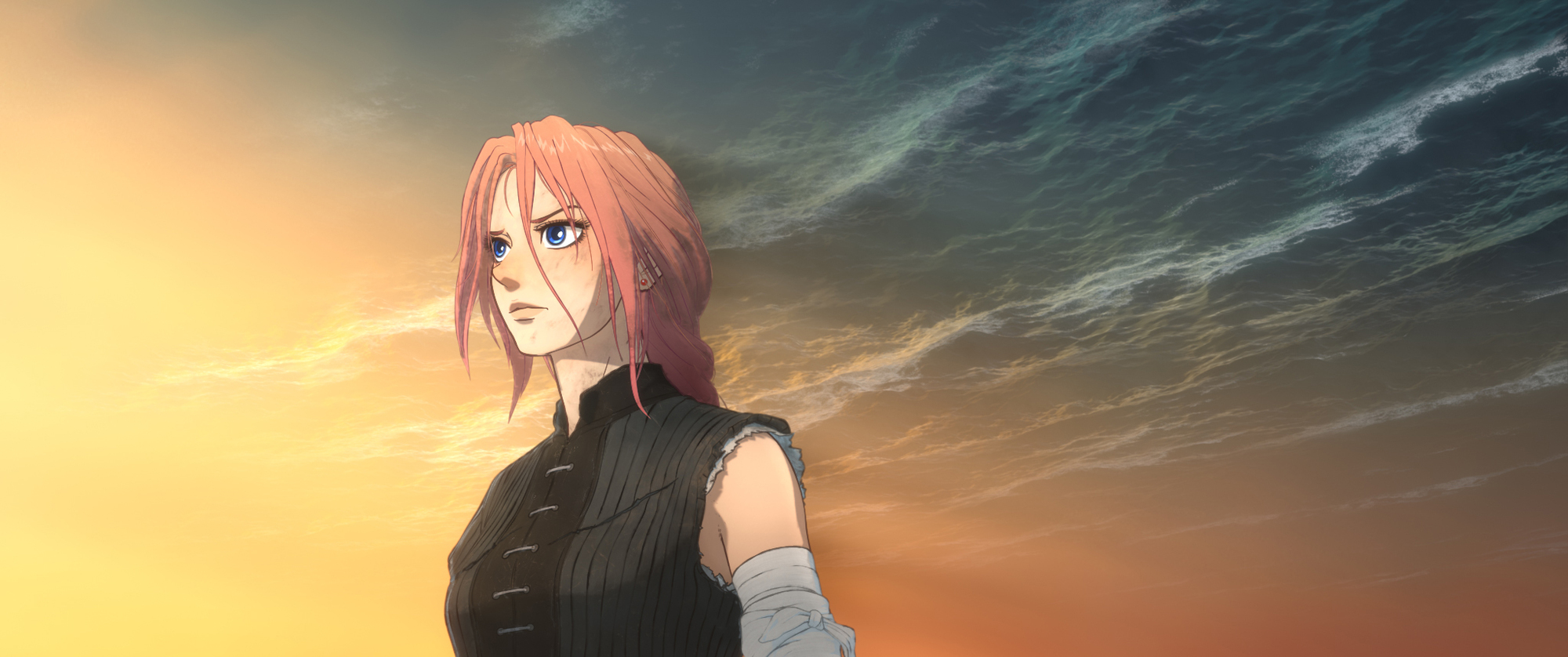
Japanese animation has often been defined as either hand-drawn 2D or fully 3DCG. But I believed there could be an expression that was neither of those. The characters in this story live close to the ground, surrounded by the smell of blood, sweat, and earth. When thinking about how to translate that physical sensation into images, I felt that the lines of traditional cel animation alone were not enough, yet the texture of pure 3D was also different from what I wanted.
So I challenged myself to create a new look that combines the softness of 2D with the depth of 3D. The lines of the characters remain alive, while light, shadow, and the texture of skin feel real. Ideally, viewers might even wonder, Is this 2D or 3D? This visual style is not simply a technical achievement, it is an expression meant to convey the characters’ emotions. For example, when Scarlet is wounded yet pushes forward, you can see the sweat on her skin and the gritty texture of sand. I wanted those details to resonate directly with the audience’s emotions. In Japan too, Directors like Isao Takahata at Studio Ghibli challenged new expressions. I believe it’s crucial not to remain confined to traditional cel animation techniques, but to challenge new expressions and expand the range of expression in animation.

The way this story transcends time and space is absolutely brilliant and it establishes a really interesting relationship between Scarlet and Hijiri. Was that connection between past and present always there throughout development, or was it something that came later on?
One of the things that was especially helpful to me while creating this story was a conversation I had during the research phase for the project with someone responsible for diplomatic policy with challenging nations. Their words left a deep impression: “When negotiating with a skeptical counterpart whose history and culture differ from ours, you can’t rely on ideals alone. Yet without an ideal to champion, you risk being swallowed by reality.” I was struck by the idea that the world moves through the tension between idealism and realism. That became the starting point for the relationship between Scarlet and Hijiri. Scarlet begins as a realist, while Hijiri begins as an idealist, and the two stand in opposition to one another. As these contrasting figures travel together and carry their own dilemmas, I wanted to follow the moments in which each of their beliefs begins to waver and change. That became a major guiding principle for the film.
Compared to some of your other projects such as BELLE, Summer Wars and Mirai, this has a completely different feel to it. Could you talk me through some of the challenges you faced when developing Scarlet?
The greatest challenge was confronting violence and death head-on. In both Summer Wars and BELLE, at their core, the stories were grounded in a sense of affirmation for family and connection, providing a warm refuge within the film. But Scarlet is the story of a girl whose father has been killed, a girl who is living with nothing but revenge. Blood is shed, people die, and hatred moves people to act. To depict that darkness head-on required a great deal of resolve for me, given the kind of films I had made until now.
At the same time, it was also difficult to maintain the line between depicting violence and condoning it. If the battle scenes were made too exhilarating, revenge could start to seem justified. But if they were restrained too much, the reality of Scarlet’s motivation for revenge would be lost. From the script all the way through to the visual expression, I remained constantly conscious of that line.
The ethical question of what to depict, and how far to depict it, weighed heavily throughout the production. For those who came to love animation after watching Summer Wars, this film may at first feel a little disorienting. But I hope they can embrace even that feeling as part of the experience.

There seem to be multiple sources of inspiration within Scarlet. There’s definitely a strong connection to Shakespeare’s Hamlet as well as Scarlet representing a Joan of Arc type figure. What else inspired you throughout Scarlet’s creation?
In terms of the world of this film, I was deeply affected by Shakespeare’s Hamlet and Dante’s Divine Comedy, which I read when I was a student, as well as by Yukio Ninagawa’s stage production of Hamlet, which I saw on television. I believe that those experiences of reading and watching theater during my student years had a major influence on the construction of this film’s setting.
There are some absolutely striking pieces of animation, from the action sequences to the fluid dances. My personal favourite was the looming presence of the giant dragon. I thought that was awesome. Was there a particular part of Scarlet that you are especially proud of?
What I’m most proud of is how I was able to properly depict Scarlet’s inner transformation. At the beginning of the story, Scarlet is a character who sets out on her journey with revenge as the sole purpose of her life. She is convinced that there is no choice left to her other than revenge. However, along the way she meets Hijiri, a Japanese nurse, and gradually, yet undeniably, her conviction begins to waver. Eventually, she is forced to confront questions such as, “What kind of life do I truly want?” and “Is revenge really the final goal?” The process in which a person who once saw nothing but revenge gradually becoming aware of life’s possibilities beyond it, to me, the most important part of this film.
In the world we live in today, cycles of retaliation and conflict seem very difficult to stop, and many people appear to have resigned themselves somewhere along the way to the idea that “this is simply human nature.” Everyone wishes for peace, yet conflict does not end. We have become paralyzed in the face of that contradiction.
But if there truly is a moment when conflict can stop, perhaps it does not begin with grand slogans or political messages. Perhaps it begins quietly, when each individual realizes that their own life matters more than revenge. How do I want to live? How do I choose my own life? When these small shifts in consciousness accumulate, perhaps even great conflicts might gradually transform. That is my hope. What Scarlet depicts is precisely this “change occurring at the individual level.” It is not the story of a hero who saves the world all at once, but the story of a single girl who chooses to reclaim a life not defined by revenge. What I am most proud of in this film is that I was able to depict that moment of choice in a way that allows the audience to feel it as something of their own.

It was an absolute pleasure to be able to hear what Hosoda had to say, and I think learning about his process really adds an extra layer of appreciation for the artform and his way of storytelling. If this is your first time encountering Hosoda’s work, I implore you to check out some of his other works- scratch that. Not some, but all of his films.
- The Girl Who Lept Through Time (2006)
- Summer Wars (2009)
- Wolf Children (2012)
- The Boy and the Beast (2015)
- Mirai (2018)
- Belle (2021)
You can read James’ ⭐⭐⭐⭐ of Scarlet right here.
Academy Award® nominated director Mamoru Hosoda returns with SCARLET only in cinemas March 13th. Don’t forget to catch up on all of the latest anime news.
