

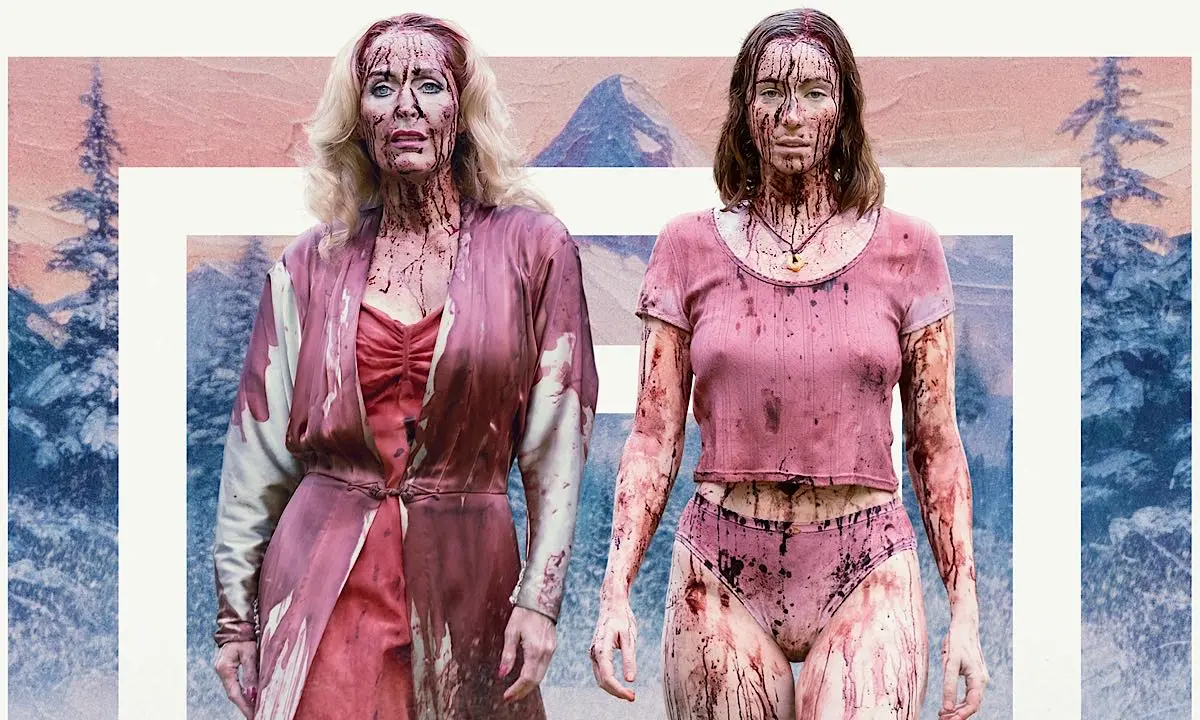
MUBI releases Teenage Sex and Death at Camp Miasma in cinemas across the UK and Ireland now.
Synopsis
After years of slapdash sequels and waning fandom, the Camp Miasma slasher franchise is handed over to an enthusiastic young director for resurrection. But when she visits the original movie’s star, a now-reclusive actress shrouded in mystery, the two women fall into a blood-soaked world of desire, fear, and delirium.
Review
Desire. This is the word that Kris – played brilliantly by Hannah Einbinder – underlines several times in her notebook when rewatching one of her favourite slasher movies: Camp Miasma.
In Jane Schoenbrun’s latest cinematic undertaking, writer-director Kris is tasked with rebooting the long-dead Camp Miasma franchise, hoping to capture the strange emotion the original evoked in her when she first saw it at the questionable age of 8.
To do this, she seeks out Billy – the franchises first ‘final girl’, played by the chronically iconic Gillian Anderson – who has been living a reclusive lifestyle on the set of the original Camp Miasma for several years, while refusing to return for further sequels.
With Billy’s help, Kris hopes to uncover the secret of her own desire – a desire psychologically inseparable from the Camp Miasma saga, and one which will take her on a journey both terrifying and exhilarating, bringing her face-to-face with the blood-thirsty – and perhaps a touch misunderstood – Little Death.
Straight away, I’m going to confirm what you already know: Gillian Anderson is wonderful in Teenage Sex and Death at Camp Miasma, her presence on the screen always welcome regardless of her role.
Usually playing graceful, stoic or stern, Anderson gets to embody a delightfully strange character this time around – whose initial crackpot charm disguises a deeper passion that comes out of hiding later on, spurred on by our protagonist, Kris.
Hannah Einbinder was the biggest surprise for me by far, however. While I had no doubt Anderson would impress, I had no knowledge of Einbinder going in to Camp Miasma, and she left a lasting impression.
Effortlessly funny, she manages to convey wonder, fear, longing and shyness in a way that kept me anchored to the bizarre and dreamlike story throughout all of its eccentricities.
This hour and fifty-two minutes of pure escapism doesn’t follow the well-worn grooves of standard film structure, playing out more like a cinematically-realised sexual awakening than your average plot-driven story.
There isn’t a rise, a fall, and then a victory against the odds. Kris very much goes from point A, to B, plants her feet firmly at point B, and then credits roll. How you feel about that will entirely depend on how you feel about what Schoenbrun chooses to replace point C with – but I’ll return to this later.
What we do get is the special kind of “art film” that doesn’t sacrifice fun for cryptic subtext or obscure symbolism – though there’s plenty of that in here, too. It gets delightfully weird, with cartoonish gore and deliberately hammy horror cliches used as set-dressing for a story laser-focused on identity, non-conformity, and the mysterious relationship between fear and – you guessed it – desire.
But it’s also fantastically written. The script is bursting with a whimsy and clever social commentary that never feels heavy-handed or self-satisfied, but sincere, inclusive and likeable.
It examines queerness – through the unexpected filter of 80s slasher horror – in a way that invites you to engage, and also, vitally, to laugh. It’s not so uber serious in its messaging that it would alienate someone from embracing the material with an open mind and a cheesy grin.
There’s a deft balance struck between a vivid fondness for the genre, and a playful critique of the fear-mongering aimed at anything non-heteronormative exhibited in horror from bygone eras.
Schoenbrun is, first and foremost, concerned with fun, and doesn’t appear to be interested in taking a critical swing at slasher conventions without first showing what it is about slasher cinema that’s so appealing in the first place.
The cinematography and set design is deliberately surreal in its composition. The camera captures exterior scenes in Wes Anderson-adjacent wide shots, allowing lake-born fog and sheets of pearl-white snow to add texture to a film vibrant with contrast.
Gaudily designed VCR tapes and discarded candy wrappers of various colours bring visual interest to the rustic cabins and old-timey theatres of Camp Miasma. Reality often blurs with Kris’ fantasy, and this is very fitting.
Because this film is really all about our fantasies, and how, for better or worse, they can shape our identities and influence our ability to connect with others – to reach out and ask for something that we don’t even consciously know that we want.
It’s a film that presents the human being as what it truly is: a confused, neurotic mish-mash of nostalgia and trauma, and the hopes and hang-ups that spring from both.
Teenage Sex and Death at Camp Miasma isn’t perfect, though. There’s a particular spree of murder – courtesy of our Jason Voorhees stand-in, Little Death – that goes on a bit too long, and is a bit too derivative of the type of over-indulgent splatter-fests threaded through many modern blockbusters.
Deadpool, Kingsman, even Guardians of the Galaxy Vol. 3 all use standout scenes of particularly spectacular violence to drive home their irreverent brand of humour. And that’s not a knock on those types of scenes – they’re very effective in the right story, and usually strike the right notes.
But for a film that’s been, up to this point, so off-beat and wry, to suddenly make me sit through the cinematic equivalent of a whoopee cushion gag for what felt like three to five minutes was a little jarring.
I find a group of walking bully clichés being diced up, impaled and otherwise mutilated in a variety of gruesomely funny ways as amusing as the next sicko, but after the first 60 seconds the punchline loses its lustre.
It’s only because in all other areas Camp Miasma so excels at being uniquely goofy and deceptively clever that it stands out so much more when it puts both uniqueness and cleverness on hold for a scene that offers nothing better in their place.
Maybe this scene was supposed to be a commentary on something that went over my head, but if so, I don’t think the point being made was worth throwing off the rhythm of an otherwise pretty seamless experience.
Finally, I said I’d get back to Camp Miasma‘s interesting structure problem. I use the word “problem” very loosely, as I’m sure this will only bother a small subsection of people (maybe even only me), but it’s worth mentioning even so.
The moment Kris makes the decision that will take her on her journey with Billy, she walks more-or-less a straight line to the end of the film. She runs into an occasional crisis of confidence, an argument with an agent or producer here and there, or a mental block that slows her progress towards her goal.
But Kris never truly reaches a point in the story where the climb ahead of her looks insurmountable. She never seems to question – in a significant way – if her chosen path is the right one. The result of this is that the ending feels like it comes surprisingly quickly and a tad too easily.
Now it’s debatable whether Kris even needs to question her path. This is clearly a very personal film for Schoenbrun, and I expect it’s at least partly based on their lived experiences. If the goal of the film was simply to capture the kind of emotional rapture you might experience when “finding yourself”, then it’s hard to critique it based on a standard the director had no interest in meeting.
As a pure, artistic representation of a person’s complete and ecstatic acceptance of who they are – sexual hang-ups and all – Teenage Sex and Death at Camp Miasma is a joyous, indisputable success.
But I would personally have liked to have seen just a few more obstacles put in Kris’ way before the curtains fell on her story, as entertaining and important as I think it was and will be for many.
Verdict
Spearheaded by fantastic performances from Einbinder and Anderson, Teenage Sex and Death at Camp Miasma is funny without being smug, clever without being pretentious, and reverential of 80s slashers without being afraid to cut them open and dig around in their guts. What you’ll discover in the gore is something as thought-provoking as it is entertaining.
⭐⭐⭐⭐
