

(or ‘How I Learned to Stop Worrying and Love the Blonde’)
I’ve always had a soft spot for Legally Blonde. A gentle satire on the trendsetting “It Girls” of 2000s L.A. and a fish-out-of-water story rolled into one, you’d be hard pressed not to crack a smile at the earnest silliness this film has to offer.
When I sat down to watch the movie 25 years after its release, the plan was to write an article about how it had aged. Did the jokes still land? Was it still culturally relevant?
Were there any parts that were – heaven forbid – problematic?
Yeah, of course. It was 2001. Though, apart from one girl saying she passed Spanish by giving her professor a lap dance, there really isn’t much that a modern viewer would raise an eyebrow at.
And I don’t know about cultural relevance, but what I do know is that the core themes of this cult classic are just as relevant as ever – and, examining these, I found the answer to a much more interesting question:
Is Legally Blonde a blueprint of stoic philosophy disguised as a feel-good comedy?
You’ve read the title of this article, so it’ll be no surprise to you that I believe the answer to be a firm – and unexpected – yes.
I understand that’s quite a claim to make without evidence to support it. Luckily, I’ve come equipped with a handful of quotes and a metric tonne of personal opinion to back it up. So strap yourself in.
“I need to marry a Jackie, not a Marilyn.”
Legally Blonde‘s opening focuses on Elle Woods (played brilliantly by Reese Witherspoon) as she exists in her status quo – within the walls of a college sorority building, surrounded by likeminded girls from rich families.
At the beginning, Elle’s goal is simple: to marry her handsome, high-status boyfriend, Ward, and achieve the fairytale life her family, friends and – most importantly – she herself expects for her.
But this goal comes crashing down when Elle is dumped by Ward at dinner for not being serious enough for someone of his status. This sends her spiralling into self-pity and isolation, which triggers all the events that follow.
There’s one important thing to note about Legally Blonde before we proceed: its central gag never outstays its welcome.
We could easily have spent an hour and thirty minutes watching a director make fun of rich L.A. girls – simply pointing and laughing at the type of superficiality we recognise in Paris Hilton and, later, the Kardashians.
But Elle’s materialist pageantry isn’t just a shallow gag – it acts as both a narrative obstacle and her biggest strength. Seeing her move from her natural environment where she was, literally, queen, to an alien space where she’s ostracised, is too compelling a dynamic shift for the gag to get stale.
It’s a joke that not only evolves over time, but drives the entire story. What could’ve been a lazy parody becomes a delightfully whimsical tale about embracing the positive attributes of your true nature, even while facing negativity, rejection and social isolation.

This is what makes Elle Woods such an inspiring symbol of stoicism.
But let me elaborate on that…
“Harvard won’t be impressed that you aced History of Polkadots…”
To broadly define the philosophy of stoicism, it revolves, primarily, around the idea of mind over matter: while we have no control over external events, we do have control over our thoughts, and how we choose to react to adversity.
So, like every good stoic, Elle doesn’t let rejection keep her down. She decides to study law at Harvard, just like Ward, to earn his respect and win back his affection. (While her attitude is stoic, her final goal is not – but we’ll return to that later).
As Elle’s friends and college advisors remind her, she hardly has qualifications that Harvard would typically value. That said, every subject she’d set her mind to previously she’d achieved the highest possible grade for. Polkadots or no, that’s pretty impressive.
Ignoring the naysayers, Elle sets about filming an admissions video essay, highlighting how managing the transition from one type of toilet paper to another and remembering the key details of a sitcom are transferable skills to studying law.
To the administration board at Harvard, while Elle’s chosen fields are questionable, her tenacity and work ethic are undeniable. Besides – they could really use some diversity in their student body…
“Elle Woods, welcome to Harvard.”
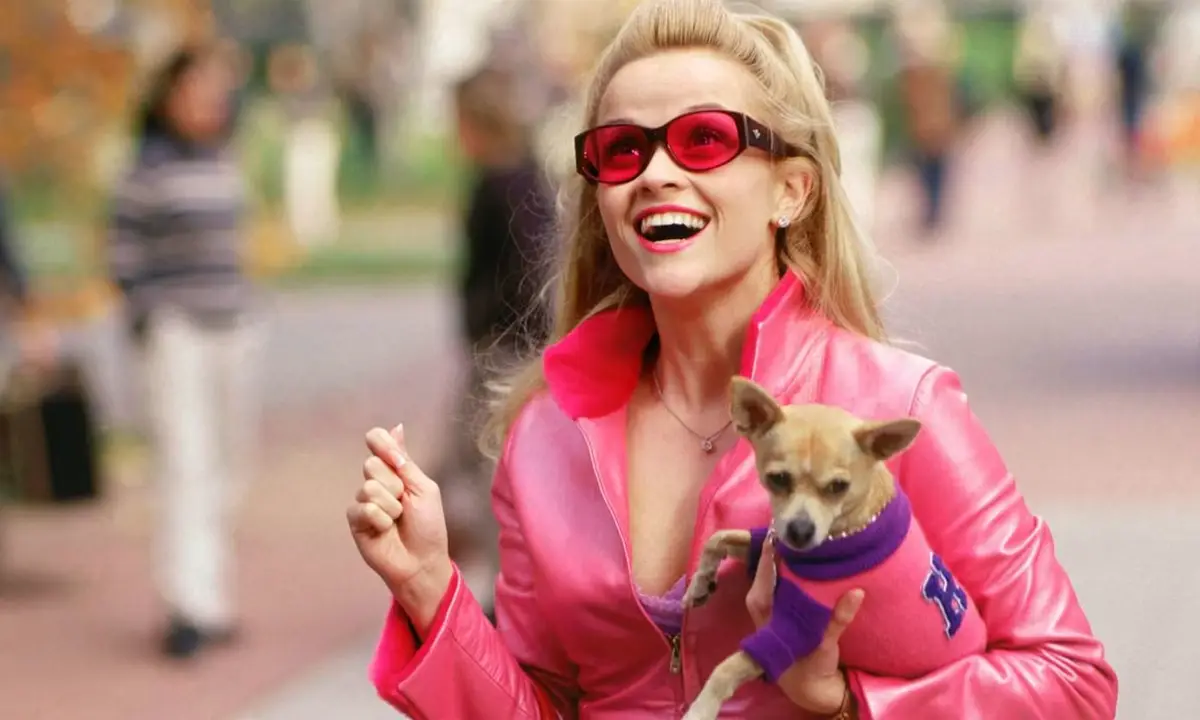
At Harvard, Elle faces immediate scrutiny (there’s that adversity again) both from teachers and fellow students. Arriving in a sports car, dressed all in pink and with a chihuahua nestled in her purse, she is immediately singled out as someone valuing style over substance.
She is talked down to by her peers, picked on by her professors, and quickly discovers that Ward is dating Vivian – a dour, intimidating girl who is meaner to Elle than anyone.
“If someone is able to show me that what I think or do is not right, I will happily change, for I seek the truth, by which no one was ever truly harmed. It is the person who continues in their self-deception and ignorance who is harmed.”
Now, the eagle-eyed super-fans reading this might have spotted that the above quote isn’t actually from Legally Blonde, it’s from Marcus Aurelius’ Meditations – a sort of stoic self-help book, to be just a tad reductive. (As a fun game, for the rest of the article, see if you can spot which quotes are from Marcus and which are from the movie).
Elle Woods embodies the sentiment of this quote throughout much of the plot. After discovering her boyfriend replaced her with someone else, her peers don’t respect her and her teachers don’t believe she’s a serious student, she changes her approach.
Elle’s improvement is gradual. She doesn’t instantly become an expert lawyer overnight, but instead gets better, little by little, as she studies.
Even as Elle starts to make headway as a law student, she refuses to surrender her personality to fit in. When invited by her professor, Callahan, to sign up for his internship, she hands him a pink, scented resume, leaving him dumbstruck.
While she absolutely refuses to conform to arbitrary standards, Elle still accepts that there are areas in which she needs to change in order to grow as an individual.
There’s a fantastic montage where we see Elle’s willingness to lead dual lives – both as the person she started out as, and as the person she wants to become. We see her studying on the treadmill and then while getting her hair done, totally absorbed in the new learning material while still immersed in the rituals of her old life.

Elle has the strength of character to try and better herself without compromising who she already is. This strength is what pushes her along the road to an unrealised goal of self-love and eudaimonia – an Ancient Greek concept often seen by stoics as the ultimate goal of life, roughly translated as “human flourishing”.
“Accept the things to which fate binds you, and love the people with whom fate brings you together, but do so with all your heart.”
OR
“Bend… and snap!”
Elle encounters many different characters while at Harvard – some at the college itself, and others at a nail salon. Of the latter, her main confidante is Paulette, played by the legendary Jennifer Coolidge.
Paulette struggles to tell the hot delivery man who stops by the salon that she likes him and, in a similar vein, lacks the confidence to get her dog back from her abusive ex.
Elle is able to use both her natural-born talents and newfound legal expertise to help Paulette with each problem in turn. She teaches her a technique called the “Bend and Snap” to seduce the delivery man, and confronts the toxic ex-husband with a stream of legal jargon, giving Paulette the confidence to take her dog back.
Here, the duality of Elle’s character is flourishing again. She begins to see that the law is a tool to be used to lift people up – not just as a means to achieve higher status.
The desire to help others was something that existed within her already, as evidenced by the ‘Bend and Snap’. But when she spontaneously takes on Paulette as a client, we really see Elle begin to embrace the potential of her education. It’s no longer just about seeking the validation of a man.
“When another blames you or hates you, or people voice similar criticisms, go to their souls, penetrate inside and see what sort of people they are. You will realise that there is no need to be racked with anxiety that they should hold any particular opinion about you.”
Elle’s peers at Harvard belittle her, prank her and underestimate her – none more so than Vivian.
It’s only after being invited by Callahan to participate as part of the defence in a murder trial that Elle starts to notice the true feelings at the core of Vivian’s resentment of her.
When Vivian confides that Callahan is always sending her to get him coffee – something he never asks of the male interns – it becomes apparent that Vivian has been fighting an upward battle all her life. She’d been struggling to stand out in a world that seemed to value women solely for their looks – a notion that Elle appeared to symbolise.
But Elle meets Vivian’s malice with kindness, making her a collaborator instead of an enemy by the final third of the film.
Once again, Elle’s natural temperament helps her overcome a type of adversity that most people would lash out at and worsen. This is a virtue that would do the Ancient Greeks proud.
“Nature has given to each conscious being every power she possesses … just as Nature converts and alters every obstacle and opposition, and fits them into their predestined place … so too the rational person is able to finesse every obstacle into an opportunity, and to use it for whatever purpose it may suit.”
OR
“Being blonde is a powerful thing … and I’d personally like to see you take that power and channel it towards the greater good”
A big talking point of stoicism is the idea of living in accordance with nature – understanding that you’ve already been equipped with all the attributes you need to succeed, and live a good life.
Elle has a crisis of faith when, while attempting to clear the name of a famous exercise guru, she is sexually harassed by her professor, Callahan. She starts to believe that she was only offered her internship based on her appearance, and not on merit.
Despite a crisis of faith caused by this revelation, Elle returns to take on the case by herself, and – with the support of her friends – wins the whole thing, trusting in her knowledge of perm maintenance to uncover the lie.
Unlike her contemporaries, who want only to climb the ladder and earn status, Elle wants simply to help people. And she ends up doing exactly that, in a way that only she could – because she has recognised the virtues already within her.
Showing up for the final showdown in the court room, Elle is dressed entirely in pink. This is her final form – equipped with new knowledge, but fully embracing who she was, and still is, without shame. Eudaimonia has been achieved.
“Our life is what our thoughts make it”
The final lesson to take away from Elle Woods – and I genuinely believe this is the most important one – is to think less.
So much heartache is caused simply by overthinking things. The true meaning behind a person’s facial expression; whether we’d be a good fit for a job; if our children will resent us when they’re older, etc.
Elle Woods is, to a large extent, oblivious to certain “realities” that other characters in the film see as extremely important. It’s partly due to this that she’s able to focus on being in the present moment, and strive for ambitious goals that would make everyone else think themselves into a corner.
Above all, Elle Woods embodies the simple stoic idea of keeping an untroubled spirit, and – as our boy Marcus says – “finessing every obstacle into an opportunity”.
Legally Blonde is a masterpiece of stoic philosophy and, I sincerely hope, in another 25 years, Reese Witherspoon will be immortalised on stained-glass windows and prayed to daily.
