

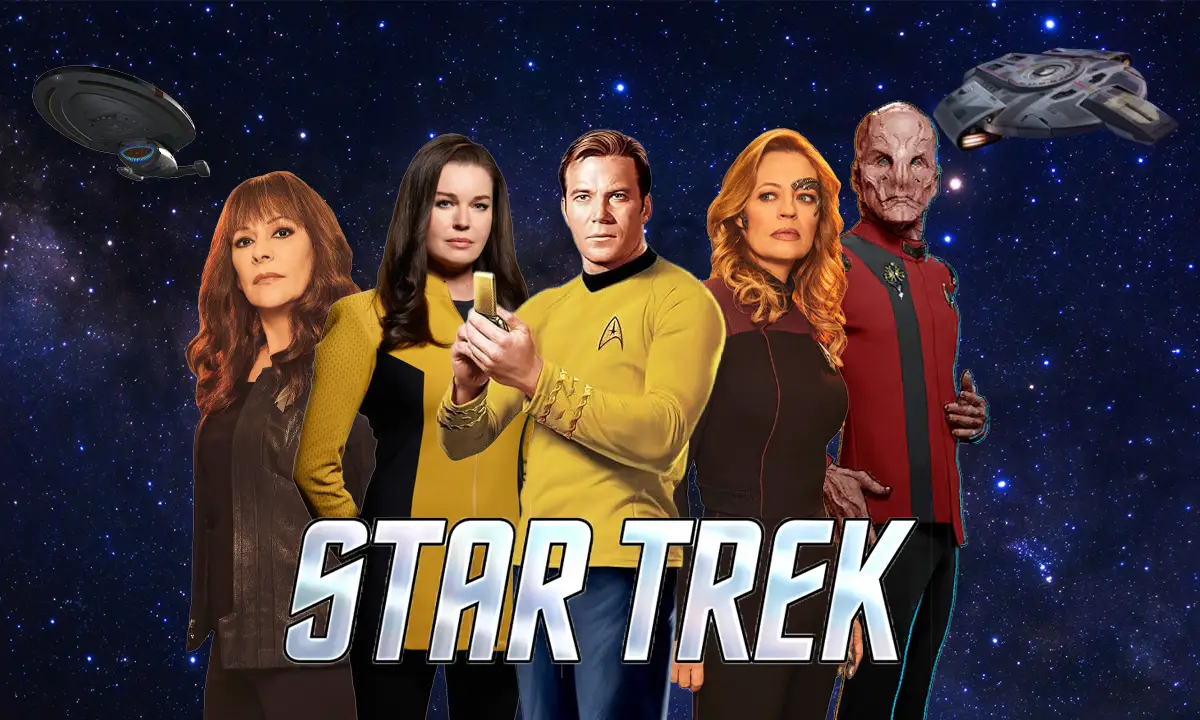
Last week I took the first in a series of deep dives into the future of Star Trek. As the veteran franchise turns 60 years old in 2026 it faces an uncertain future on all fronts as Paramount finds itself under new management. Today I’m returning to the final frontier to look at what might come next for the franchise in its original home on the small screen.
Whilst The Original Series may have only lasted 79 episodes between 1966 and 1969, the franchise has gone on to air a total of 960 episodes of Television. An impressive number for a franchise which was originally cancelled and resigned to the sci-fi scrap heap. In the streaming age alone, between Star Trek: Discovery and this year’s Starfleet Academy there has been 235 episodes under the watchful eye of Head of Trek, Alex Kurtzman.
But this year Kurtzman’s deal comes to an end. Having originally joined the franchise in 2018 he now finds himself with no active series following the cancellation of Academy and new bosses who may wish to take the franchise in a different direction. With fans split between the 2400’s and Discovery’s place in the 32nd century the studio is faced with a conundrum. What Star Trek is most likely to ignite audience interest? Is that crowd-pleasing Trek the same version of the franchise that long-time fans are looking for?
Legacy Timelines… and Legacy Characters?

The word on the lips of almost every fan of the franchise is Legacy. Specifically Star Trek: Legacy, the series pitched by Star Trek: Picard season 3 showrunner Terry Matalas. The series which would have continued the adventures of Captain Seven-of-Nine (Jeri Ryan) and the crew of the U.S.S. Enterprise NCC-1701-G. Rumour speculates that Matalas wrote a lengthy treatment for the series but with only limited budget and three other series in active production there was no room at the inn for Legacy.
If Paramount’s new management is looking for a quick win to get Trek fans on board then Legacy may well be the series to do it. Hear me out on this one. Outside of more adventures with Seven and Raffi (Michelle Hurd), bringing Star Trek: Legacy to life as part of the franchise’s 60th anniversary would bring the series back to where it began, the Enterprise. Whilst Kirk and Spock might be the most recognisable characters in the franchise, there’s no denying that the Enterprise alone is a big draw for the audience.
The idea of Legacy is clearly popular. IDW Publishing recently announced an entire comic book series, a new flagship title for Star Trek, which will continue the adventures of the new Enterprise and her crew.
Sponsored: Order Star Trek: The Original Series – Complete Box Set on Amazon
As I explored in last week’s piece where Star Trek may find itself on the big screen. The idea of returning to the 2400’s offers up huge storytelling opportunities. Post-Borg, post-Dominion, post-Voyager. There are endless combinations of returning characters and narrative plot threads which could drive the franchise forward into a new era. The foundations of a shared universe of storytelling speak for themselves. Save huge adventure plot lines for the big screen. Overlap those with smaller, episodic explorative storylines on the small screen. Immediately you have an opportunity for cross-platform storytelling which could really resonate with a wider audience.
It presents the opportunity to capture new audiences by telling new stories with new characters. But, just as I mused about films, you have the opportunity for legacy characters to appear in supporting roles to help maintain continuity. Picard showed the interest and proved the formula, stirring up interest from the fan base to see other classic characters – Kate Mulgrew’s Admiral Janeway being chief amongst them – and even had legacy actors like Scott Bakula pitching limited series based on what their characters got up to after their original series ended.
Seeking Out New Life and New… Showrunners?
The biggest question that hangs over the future of Star Trek on the small screen is whether Alex Kurtzman will remain in charge. Plenty will tell you his time in the captain’s chair has been divisive. But cut through the social media nonsense and the long-time J.J. Abrams collaborator has presided over an incredibly creative and fruitful decade of television.
On the one hand new Paramount CEO David Ellison has a pre-packaged, fully up-and-running chief to steer the ship. But with his only remaining series, Strange New Worlds and Starfleet Academy, both set to end in the next couple of years could that be a sign that he’s about to move on to pastures new? Should Kurtzman step away from Trek who could take over and get back on course? The obvious answer is Terry Matalas, having made such a huge impression with his work on Picard. But having only worked as a showrunner could he fulfil masterminding an entire universe? Especially if the studio is looking to align the theatrical and small screen versions of the franchise?
Stating the obvious, but what Star Trek needs is its own Kevin Feige. Someone with the capability to juggle multiple huge irons in the fire across a sprawling multimedia landscape. Feige has proven time and time again that he can handle sprawling storytelling across multiple projects with their own unique creative teams. That kind of model could be exactly what Star Trek needs. But in recent years perhaps a different model has proven itself more stable. Instead perhaps Paramount should look in-house to its merger with Warner Bros. and take a cue from the DC Studios model. Hiring a creative lead (a la James Gunn) who can oversee the storytelling across all projects and pair them with a production lead (a la Peter Safran) who fully understands the business and can take the pressure off the franchise creative chief.
As for who that might be? Your guess is as good as mine. But what I do know is that Star Trek was written off in 1969 as a failure and now I’m here writing about the 60th anniversary of a franchise beloved by generations of families across the world. The 60th anniversary isn’t a funeral parade, it’s the starting gun on a brand new era which – with proper creative management – could finally see the franchise given the adoration it so deserves.
Tune back in next week as I look at the future of the franchise in comic books.
