

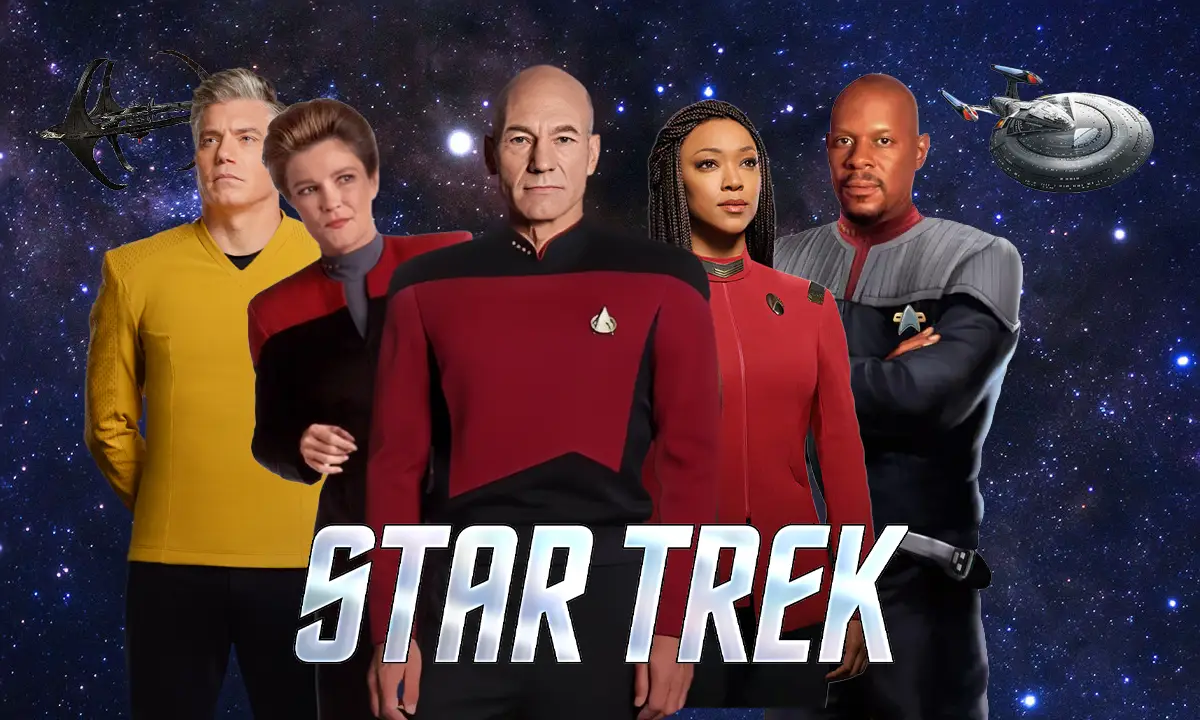
This year we celebrate 60 years since the U.S.S. Enterprise began her maiden voyage. 60 years since William Shatner first donned the mustard Starfleet Uniform of Captain James T. Kirk and began a journey which now includes 13 theatrically released movies and 960 episodes (so far) of television. But as Star Trek turns 60, new management at Paramount and an ever-shifting streaming landscape mean the future is far from certain.
Paramount Pictures’ new owner, David Ellison, has a history with the franchise having produced J.J. Abrams’ Kelvin timeline movies during his tenure as C.E.O. of Skydance Media. Having been installed as the head of Paramount he could be the man to finally re-unify Star Trek across its theatrical and TV brands. But what of Alex Kurtzman? The architect of Star Trek’s small screen renaissance has overseen its TV output since 2018. But his deal ends this year and there is no guarantee Ellison will keep him on.
As this anniversary year gets underway the last remaining active Star Trek series on Paramount+, Starfleet Academy, has been cancelled. For the first time since 2018 there is no Trek series in active production. Whilst there are 10 more episodes of Academy and 16 of Strange New Worlds left to air, once those are done the current era of Star Trek television may come to an end.
On the big screen there is hope. John Francis Daley and his filmmaking partner Jonathan Goldstein are currently working on the script for a Star Trek film they would produce and direct. The duo behind Game Night and Paramount’s Dungeons & Dragons could relaunch the big screen branch of the franchise. But nothing in this world is certain until the cameras begin rolling.
So where might the franchise go next? As a lifelong fan, I’m taking a look at what I think could be next as we boldly go into an uncertain future…
Boldly Going Back to the Cinema…

2026 isn’t just the 60th anniversary of Star Trek. This year also marks a full decade since the last Trek movie, Star Trek Beyond, landed in cinemas. Justin Lin (Fast & Furious 6) took over the director’s chair and celebrated the franchise’s 50th anniversary using a script by Simon Pegg, who plays Scotty in the Kelvin timeline, and writing partner Doug Jung. Though it grossed $345.5M at the global box office it was the lowest grossing film of the so-called Kelvin timeline trilogy.
Much of the next decade has been spent attempting to get either a Star Trek 4 or different film off the ground. Even Quentin Tarantino took a shot at writing a Star Trek film. But not even a career as legendary as his could get production off the ground. Matt Shakman (WandaVision) came closest to getting cameras rolling. Having boarded a Trek project in summer 2021, Shakman remained with the project until August 2022 when he jumped ship to return to Marvel to direct The Fantastic Four: First Steps.
In November 2025, with Ellison now in charge, the studio doubled-down on prioritising Trek as one of the pillars of the studio. With those positive statements came the news that Jonathan Goldstein and John Francis Daley were set to write, produce and direct a brand new Star Trek film. Though with no update since that initial announcement, little is known about the setting of the film and where it might sit in the franchise’s sprawling timeline.
Journeying to a New Old Timeline…
What do fans want from any new Star Trek film? Though the Kelvin timeline films grossed over $1.1B in total the time feels right to bring something original back to the franchise. It’s easy to see that fans struggled with Star Trek: Discovery as another prequel TV series, a hangover which has had a lesser impact on Strange New Worlds. Whilst other series like Star Trek: Lower Decks, Prodigy and Picard have been praised for telling stories in the “present day” of Star Trek.
Sponsored: Order the Star Trek: Picard – Complete Box Set on Amazon
The popularity of the “present day” of Star Trek, defined as on or around the year 2401 seen in Picard season 3, is also extremely apparent in the pages of IDW Publishing’s Star Trek comic books. Aside from the future set The Last Starship, IDW has predominantly stuck to stories set around the time of the 1990’s TV series through to Picard. So Goldstein and Daley would be well placed to look at that era as the perfect place to begin a new franchise for cinemas.

Why are the 2400’s so popular? The Federation and Starfleet are in a period of recovery following the Dominion War depicted in Star Trek: Deep Space Nine. The U.S.S. Voyager has returned from the delta quadrant returning Captain (or Admiral as seen in Star Trek: Nemesis) Janeway and her crew home to their families. The Borg have seemingly been disabled thanks to both Janeway and Picard’s actions opening the door for the franchise to return to a period of exploration and discovery.
The obvious option is that if Paramount+ continues to ignore fans’ calls for a Star Trek: Legacy TV series pitch from Picard season 3 showrunner Terry Matalas, to bring that storyline to the big screen. Return the franchise to the U.S.S. Enterprise, now the NCC-1701-G model, under the captaincy of Seven-of Nine (Jeri Ryan). A big screen adventure featuring the latest ship to be called Enterprise could pick up on the closing moments of Picard season 3, returning the franchise to the 2400’s AND opening up the opportunity for legacy characters to appear in supporting roles to an all-new, young crew.
If Picard season 3 taught us anything it was that tying together all the continuities from the 1990’s TV series and movies is proven gold for the franchise. Fans adore seeing Sir Patrick Stewart back alongside Brent Spiner, Marina Sirtis and the rest of his classic crew. That popularity only grows when folding in characters and thematic ideas from both Deep Space Nine and Voyager. But that doesn’t mean the studio is beholden to making these characters the leads in any future project.
As much as an Enterprise-G set story would be a license to print money, an entirely original project set in the same time period is also guaranteed to pique the interest of long-time fans. There is still the potential for conflict, introducing a new foe for the Federation or returning to old enemies like the Dominion if the story were right. Goldstein and Daley could easily create a new ship and a new cast, placing them inside the already incredibly well realised world of the 2400’s. The creative freedom of having the history already laid out affords the team the opportunity to really hone in on an exciting, character-driven story that builds on the legacy of the last 60 years whilst hopefully capturing a new audience.
What’s most important is Star Trek has always been a cult, niche hit. Though it has survived six decades the franchise has never been a Marvel-level hit. Any future on film should be driven by a modest budget, allowing for the kind of visual effects a space-set story needs. But never striving for a billion dollar box office return. The average gross for a Star Trek film sits at a little over $174M, that’s also the average budget of the Kelvin timeline movies. To make money Paramount needs first think carefully about its outlay.
Creating Star Trek on a modest budget may mean sacrificing big names for unknown actors. But could anyone name Leonard Nimoy or Michael Dorn before their iconic Trek roles? The franchise has built that 60 year legacy without consistently trading on the popularity of big name actors in lead roles, instead opting for less familiar or completely unknown faces. There’s no need for that tradition to change in a new era. Particularly if legacy actors are willing to jump in front of the camera for cameo and supporting roles to pass the baton.
Whatever the future holds, it seems Paramount circa 2026 is committed to bringing Star Trek back to cinemas and that can only be a good thing for fans. Where the future takes us is a path we can only hope the 60th anniversary celebrations can help to make clear. But whatever course we plot next, I’ll certainly be there to see where it leads.
Tune back in next week for Part Two of my feature: The Small Screen Frontier.
