

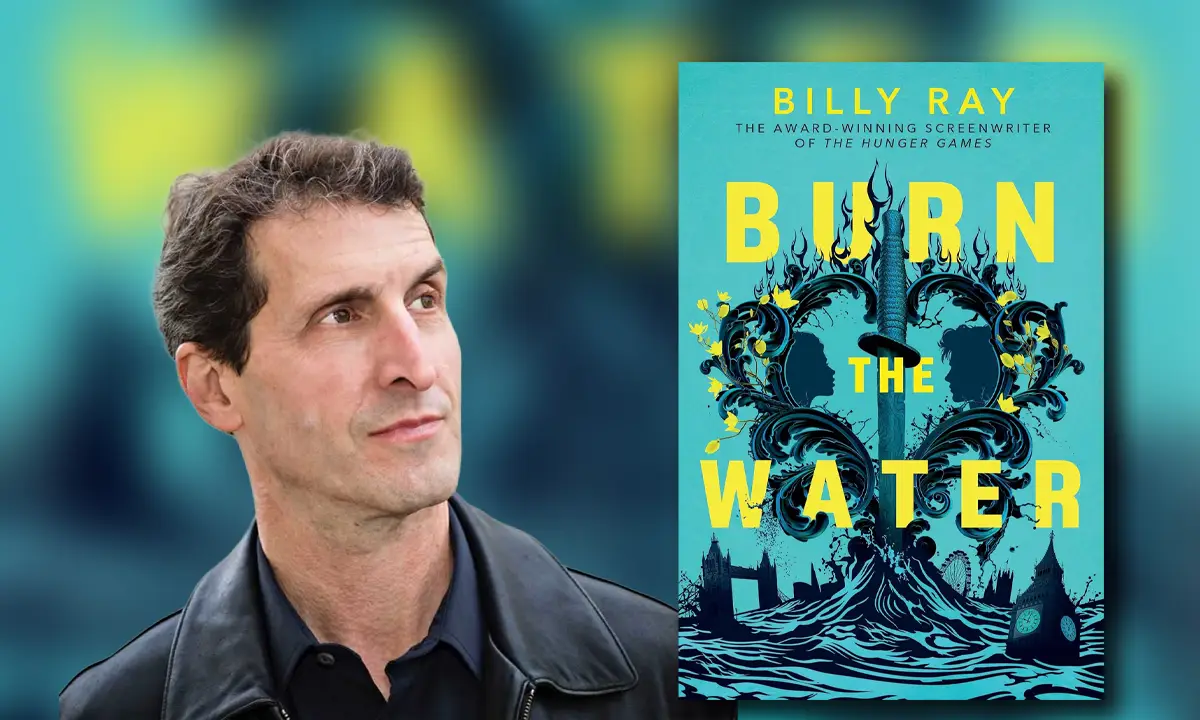
Oscar-nominated screenwriter Billy Ray knows dystopia like the back of his hand, having written the script for The Hunger Games (2012), and its much anticipated prequel The Hunger Games: Sunrise On The Reaping (releasing November 2026.) But now, he’s ready to forge his own path in his debut novel, Burn The Water.
Burn The Water, available in stores now, is rooted in London – four hundred years in the future. After rising sea levels have decimated the globe, cities are left damaged and fragmented. London is flooded, with its citizens splitting into two factions, the Rogues and the Crowns, who are locked in a deadly war. Their respective soldiers Rafe and Jule are doing all they can to ensure their camp’s victory – but when an unexpected romance surfaces, their priorities take an entirely different turn.
In this interview, Bella sat down with Billy to discuss the book’s influences, its take on war and politics, and what younger readers really need to hear. You can watch the full interview, and read it, below:
NB: This interview has been edited for length and clarity
Bella (GYCO): So, today, I’m really excited to be talking to screenwriter Billy Ray – how are you doing?
Billy Ray (BR): I’m doing very well, it’s a pleasure to be here.
Bella: It’s really lovely to meet you. I really, really enjoyed reading your book – I struggled to put it down, to be honest. I read it in about a week, and I’m a slow reader! I was wondering if you could start us off by introducing us to the book, Burn The Water.
BR: Burn The Water is set in London, about 400 hundred years from now. It’s a very different city than it is at the moment, in a very, very different world. It’s 90% under water, and it has lost communication with the rest of the globe. There’s no power, there’s no internet, there’s no comms – there’s nothing. And no one in London knows if the rest of the world even exists or not. Because the rest of world has similarly been knocked out by 400 years of deluge and wars in the city itself.
10% of the land is liveable – it’s called the dry town. And it’s being fought over by these two rival gangs – the Rogues and the Crowns. And that war has been going on for 300 years. And it’s been brutal. The greatest soldier in the Rogues is a captain named Rafe. And the greatest soldier for the Crowns, is a captain named Jule.
They’re both sub-twenty, they meet, and they fall in love. And the book then examines what will become of that, what happened to them, what happened to the city, and more specifically, what’s going to happen to Jule, and how is she going to turn into the person that ultimately is going to have to unite not just London, but the entire country?
Bella: That was a beautiful summary. I really loved the book, and I really loved all of the different references that you could pick up on when you were reading it. Like, I think there were some echoes towards The Hunger Games, with the actual point of survival.
But also, I really liked the whole throughline of Romeo and Juliet and how you kind of subverted it in different ways. I think Rafe and Jule were really well-written characters; it’s so hard to write really strong characters sometimes, especially female characters, who you really want to do justice.
So I was wondering how you approached writing both of them.
BR: Well, this really started as a love letter from me to Shakespeare. You know, when you write for a living, one thing is that it’s a relief that you never have to worry about trying to be the best at it, because that position is taken. We’re all fighting for second place, and that is actually calming to me. But I’ve always loved Shakespeare and I’ve always loved Romeo and Juliet and I wanted to find another way into it. And so I started to wonder, what would Romeo and Juliet look like in the future? And then everything came out of that.
Once that was set, I didn’t want my Jule to be modelled after Juliet. I wanted my Jule to be a warrior. And I wanted her to be the equal of Rafe, if not the better of Rafe in so many ways. And I wanted them to see in each other things that they want to emulate. I wanted them to inspire each other to be more than they were. And that’s where all the character stuff comes from.
Bella: That’s beautiful. I loved how you wrote the romance because, there was a part of me that could really tell you were trying to appreciate the things I think we take for granted right now. Especially things like music. There were several passages that made me really want to re-listen to the songs that you reference.
On that topic, I really like that one of the book’s messages is about appreciating what we have right now. It’s set in a time where there’s no electricity, and nature has completely reclaimed the world. And emotions are everything that the characters have. In this time of division and destruction, was it really important for you to emphasize connection and humanity in this book?
BR: I mean, the title for me of Burn The Water speaks to the idea of impossibility. That’s why I chose that title because you can’t burn water, and everything that Rafe and Jule are trying to do seems impossible. The idea of uniting the Rogues and the Crowns, the idea of making this war end – that just seems impossible in the world that they’re in. Much like to many people here in America, it seems impossible. But, it is not impossible.
It is actually the natural human state, to come together and to want community. It’s very easy to lose sight of that, if we play identity politics – that’s a kind of unsophisticated term for this very devious kind of tribalism. I’ve now seen it literally threaten to tear my country apart – although it’s clearly going to fail, and the country is absolutely going to come back together. And it’s really clear that that’s starting to happen already.
But I wanted to take it to its extreme, in 400 hundred years, and see what would happen if you reduced humankind to its essence. And these two 18 year old kids were in charge of leading us to our best selves. That was what the examination was for me.
Bella: On that topic, I think children are such a big aspect of this book. I think I can tell that your side as a parent came through, because there are some descriptions of the moments where the parents are separated from their children, and they are seeing the casualties of war.
And, there is a very strong political element in this book, and war is the main throughline. There were some lines that I actually really liked that I took note of – one that I think really resonates right now was a line that said, “All of this over the colour of a piece of cloth.’
So I was wondering why this was the right time to not just make this a love story, but also make this a story about war?
BR: Well, when I would give drafts of the book to people – and these are people who have been reading my writing as a screenwriter for nearly 40 years – this was the first time I had ever gave them a book. And what I would ask when they were finished, as I was going from draft to draft, I would ask them the same three questions.
Were you ever bored? Were you ever lost? And those answers were always no, which was very, very heartening. And the third was, ‘Did I get the balance right between romance, war, and politics?’ ‘Did any of those three things feels underserved?’ And when I finally started getting back that the answer was no, then I knew it was ready to go out to publishers, to try to find a home for it.
I wanted to describe a world in which there was love, war and politics in equal measure, and show how love winds up being the most powerful of the three. But in order to do that, you have to have a lot of war – and I did love writing those battle scenes. And you have to have a lot of politics, about the way people use war and manipulate one another in order to try to gain power. If you throw enough at those and thereby create a world that people in our world can recognize, then I think you’ve got them.
And then you can hit them with, ‘But, watch what love does.’ The idea was take a glass of water – that’s our world. Put one drop of blue dye in it – that’s love. And watch how the whole thing turns blue.
Bella: I think in the times that we’re living in, that will be very important for teens to really get into their brains. Even if the world feels really contentious and full of hatred right now, even a tiny positive example of love or happiness or peace is just super important.
So I was wondering what you want your adolescent readers, to take away from this book the most.
BR: Well, exactly that – hope. And I want them to know that they have agency. They can do more than they think. I do a lot of work in the political space for free, and I’m talking a lot about how we get younger voters in America engaged and how we inspire them, to go and fight for the things that they really care about, like democracy, the environment – both which are central to the book.
But I want them to see that this 18 year old girl does all that. And under the most horrific of circumstances, she and Rafe, they keep driving – and they become a force for good, that changes the country. And I want kids to know that’s possible.
Bella: That’s really beautiful. I think that is one of the most simple messages that you can send out right now – reminding young people that even if you look at the news, and everything feels bleak, and you feel like you have absolutely no power, they actually do. And I think Rafe and Jule are really shining examples of that.
