

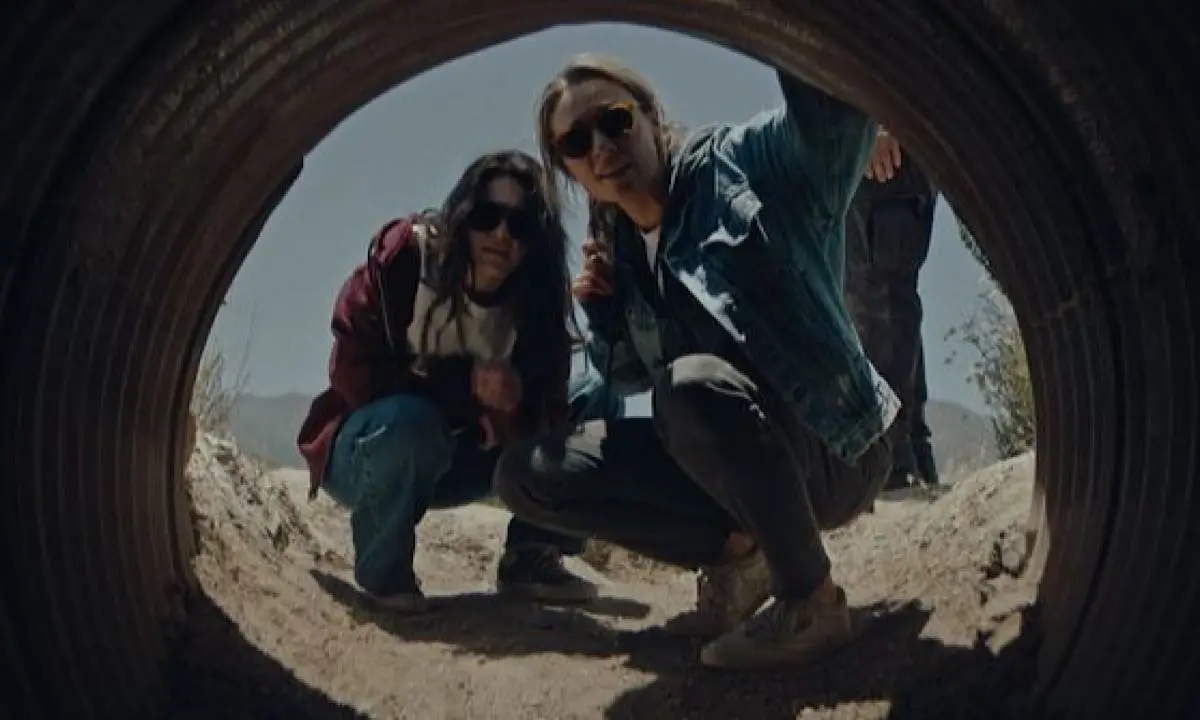
Redux Redux is available to purchase on digital platforms in the UK now from Blue Finch Film Releasing.
Synopsis
Irene Kelly travels through parallel universes, repeatedly killing her daughter’s murderer. As she becomes consumed by vengeance, her humanity hangs in the balance.
Review
I was immediately drawn to Redux Redux by its premise alone. The concept of a person literally addicted to revenge, in a cosmic cycle that allows them an unending supply of it, is genuinely a fantastic one.
Irene, a woman with access to multidimensional travel, spends her days hopping between subtly differing mirror realities, looking for one where her daughter hasn’t been murdered, and – never finding it – settles for killing the man responsible, over and over again.
The main draw of sci-fi is that it applies an infeasible hypothetical to a more than feasible scenario and spitballs what the outcome would be, either giving a definitive answer of its own or letting the audience decide for themselves.
In the case of Redux Redux, the hypothetical posed by writer-directors Kevin and Matthew McManus is: “What would a person become if technology made their obsession entirely sustainable?”.
Obviously we have lots of technologies that do that – TikTok, Instagram and YouTube are all designed to sustain our obsessions, and often the result isn’t so good. But what if the obsession was revenge?
This is the kind of hypothetical sci-fi thrillers were made for.
Unfortunately, the answer the McManus’s provide us lacks any real teeth, and is delivered in such a ham-fisted way that the viewer isn’t even granted the luxury of making their own mind up.
Around the 20 minute mark – following a satisfying, competently shot car chase – it became clear that Redux Redux would be quite happy to stare me in the eye and tell me, point blank, exactly what it was about.
At two instances our protagonist, Irene, played by Michaela McManus, drops a page of exposition on us – in the first case outright explaining her dimension hopping to a love interest, and in the second, telling her teenage confidante how this dimension hopping has drained her of her humanity.
Before the first dump, there’s a blissful stage of time where I was told nothing. Irene went about her daily routine, killing multiple versions of the same man, investigating the keepsakes he collected from his victims, revisiting the same diner in different realities, etc.
These things were never explained. I had to piece them together and figure out what was going on, and when Irene first used her dimension-hopping machine, everything clicked. This was a joy. I was being invited to engage with the film. I wanted to see what Irene’s deal was.
And then I found out what Irene’s deal was. Because she fully announced it, subtext-free, 20 minutes into the film. We’re told she’s caught in a cycle of vengeance, that she’s not in a good way – and I was left wishing that I’d been left to figure this out for myself.
Clumsily communicated exposition aside, this teary-eyed confession just comes too early in the film for anyone to really care about it, and so it’s robbed of any real emotional impact.
Irene’s obsession is also never at any point presented as a flaw in her character, or presented as an obstacle to her bonding with Mia – a runaway orphan she later recruits. I got the impression that the filmmakers wanted to sell me on a story about someone who’s hit rock bottom, but didn’t actually want to demonstrate that through Michaela McManus’ performance
Irene, as a protagonist, is a little bland. For someone jumping from dimension to dimension to kill her daughter’s murderer again and again, she always comes across as remarkably sane.
We ought to be looking at a lost soul; a junkie, almost frothing at the mouth to kill the next spectre of her daughter’s killer – not a generally mild-mannered, likeable, straight-edged lady who makes killing the same man over and over seem like working a 9 to 5.
I fully understand that everyone reacts to trauma differently, and sometimes it can present itself in people as numbness – even apparent calm. Perhaps her indifference to the killing was a deliberate attempt to show how she’s become so accustomed to her new pattern that it’s become humdrum.
But despite the intention, I still expect to see Irene have to deal with genuine set-backs in the plot that are caused by her trauma. For practically the entire runtime she is relatively amenable, never causes unnecessary harm to others and at no point believably sells herself as someone who’s “lost any humanity [she] had left” – she simply tells you that she has.
If a person is losing themselves to revenge, this should be reflected through demonstrably negative behaviours. Killing horrible people who, let’s be honest, sort of had it coming, is not enough to push the idea that Irene is lost to her urges and fighting back personal demons. That’s pretty standard action hero stuff, and can’t be considered a genuine flaw by movie logic.
Mia, a foster child that Irene saves from her daughter’s murderer, is essentially the second protagonist, and we even follow her briefly on a solo adventure at one point. She’s supposed to bounce off of Irene; cause friction; be an obstacle.
But while there was a chance for conflict (partnering up two characters with opposing views) Irene and Mia essentially approve of each other from the outset, the only conflict coming from Mia wanting to help Irene, and Irene (very sensibly) wanting her out of trouble.
But this is the problem: Irene shouldn’t really be sensible. If, like the movie keeps telling us, she’s lost touch with her humanity, then surely the conflict should come from her being reckless, even to the point of endangering a child – to the point where she loses sight of what this whole crusade was about in the first place: making sure no one has to lose a child to this murderer ever again.
Because Irene doesn’t seem like a person in crisis, with any recognisable personal flaws to mend, the emotional stakes are flimsy and there’s little to cling on to narratively. The obstacles presented always come from outside and never from within, and that doesn’t allow for character growth.
The only thing at stake is that maybe Irene and Mia won’t be able to kill the bad guy for the thousandth time, which is a pretty hollow goal considering – having seen him die on multiple occasions – he no longer seems all that threatening.
Reaching the end of act two the aims of our protagonists seem fuzzy and unimportant. What do they both need? And why is their behaviour or their circumstances preventing them from getting it? These questions weren’t answered (if they were even asked) in a way that compelled me to keep watching.
By the time the third act swings round, Irene is left with an empty, obvious decision that is ultimately made for her by a happy coincidence.
Without this coincidence, she likely would never have made the call that she did, therefore being stripped of any proper agency and denying the audience a glimpse at any true meaning. If the decision is easy, there’s no story.
So, without a proper exploration of the themes of revenge and addiction, we’re left with three other elements of the genre that could still make this movie a fun time: action, tension and sci-fi wizardry.
A big problem is that Redux Redux forgoes a lot of the sci-fi jargon and complexity of most dimension-spanning movies to focus on a more human story, and then does almost nothing of substance with the themes and ideas it sacrificed so much world-building to make room for.
So we’re ultimately left with vague and paper-thin explanations of interdimensional travel with nothing much to make up for this missing piece.
Aside from some satisfying, and, for some, potentially cathartic kills throughout, the action peaks with its initial car chase and escape. We get some serviceable shootouts and the occasional “Ooooo” moment when a wrong’un really gets what’s coming to them, but they’re too few and far between to make up for some of the more boring dialogue scenes at multiple diners and truck stops.
When the ending finally comes, there’s some good tension, with a race-against-the-clock dynamism that kept me engaged. But, as mentioned, the decision Irene made to get to this point was such a non-decision that it just feels like it was an inevitability from the start, and so you’re never truly concerned that the good guys might not make it out alive.
After all, why would anything unexpected happen at this stage when everything before it has followed such a consistently predictable pattern?
Verdict
With paper-thin sci-fi elements that only exist to serve a revenge plot – and a revenge plot that’s not particularly deep either – Redux Redux is a bit disappointing, considering its strong opening. A few satisfying action beats can’t save a script that refuses to let its characters make meaningful choices.
⭐⭐
