

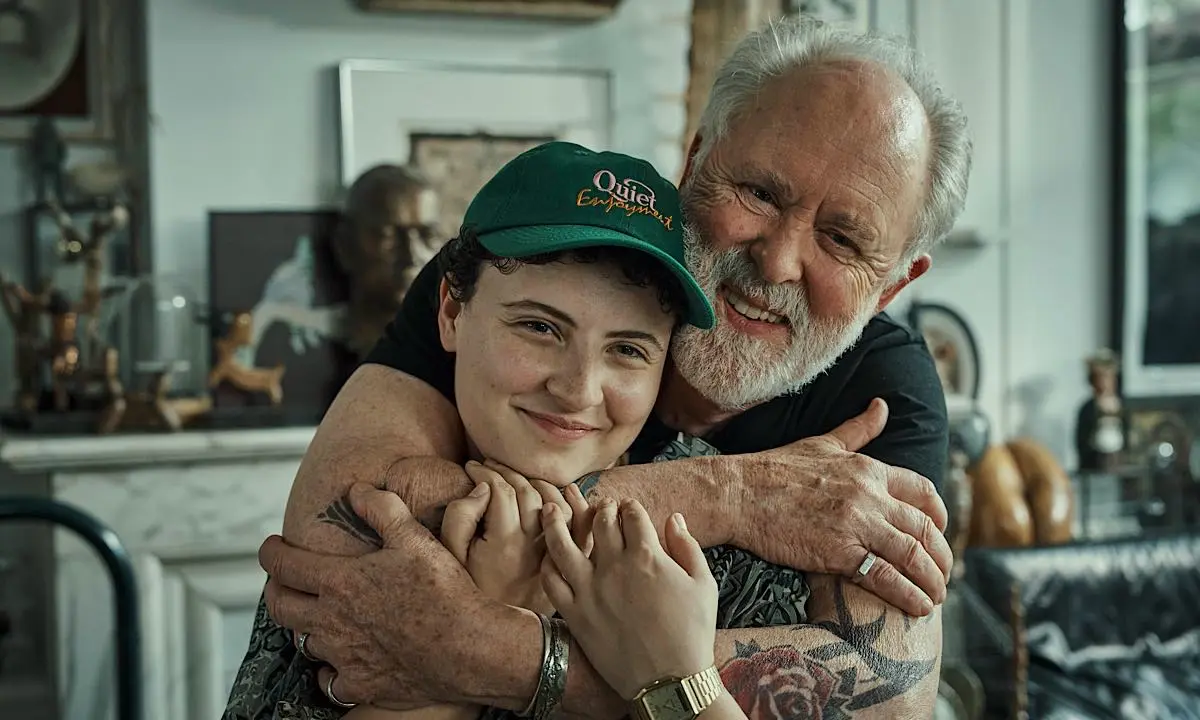
Jimpa is available on Digital HD on May 11, 2026. Distributed by Signature Entertainment.
Synopsis
Filmmaker Hannah travels to Amsterdam with her non-binary teenager, to stay with her gay father, who is known as ‘Jimpa.’ Tensions arise when Frances decides they want to live with their grandfather – and Hannah is forced to confront repressed emotions and startling changes.
Review
At the beginning of the film, Olivia Colman’s Hannah invites a room of acting students to look at the hands of their partner, followed by their face. She explains that there is an ‘instant intimacy’‘ in doing so. It is clear that Jimpa, as a film, wants an intimacy with its audience; its chief concern is connecting with you, so that you may grasp the complexities of sexuality and love. But, unlike the intricate lines of your curved palm, Jimpa is resoundingly undefined – with little buried substance to dig into.
From the BAFTA-nominated director Sophie Hyde comes this semi-autobiographical tale of tension and truth. Known for her work on Animals (2019) and Good Luck To You, Leo Grande (2022), Hyde is no stranger to emotional realism and stark sexuality. In Jimpa, she works hard to make the connective tissue fit; from drilling to the core of a cross-generational family to the complexities of youthful self-discovery, the film is never quite sure where it wants to turn. Its inconsistent tone bites away at the scenery until it begins to rupture. Hyde piles her plate high with meaty pickings, only to leave her viewer stuffed, yet strangely ravenous for more richness.
Olivia Colman and John Lithgow’s performance exemplify the film’s tonal shortcomings, despite delivering familial drama with levity. We are told by Hannah that Jimpa was once a fierce political advocate for gay rights, who challenged the agenda he constantly defied. When his family visit, he is delightfully polarising as to provoke, poking fun at displays of heterosexuality and referring to Frances as his ‘Grand-Thing.’ Lithgow brings the required warmth and occasional heat the role requires, kindling remembrances of our own treasured, out-of-touch relatives. But, perhaps the titular Jimpa would’ve been better serviced if he was not defined by his quirkiness, his unique displays of outspokenness.
Colman’s performance demonstrates her prowess as a dramatist; she doesn’t have to do much besides flash her empathetic eyes, and we’re on her side. In the film’s final sequences, she truly opens the film up to us for the first time. An impassioned monologue allows her to realise she has always been trying to cope with her past, and with her relationship to her father. But her character suffers a similar fate as Jimpa. At one point in the film, her father asks her to state who she is before entering the living room. Hannah fires off the list, that she is a filmmaker, a mother, a woman and a daughter. Hyde attempts to grant us intimacy with Hannah by showing all of her facets, all of her internal workings. But, one can’t help but wonder that if she had just spotlit a single factor that Hannah would’ve been more relatable, believable.
Amongst the many colluding tales of Jimpa, queer love is heralded and celebrated throughout. Characters speak freely of intimate encounters, explore their identities and bodies in the natural embrace of forests, shine and ripple against the glitter ball of a dance floor. But, as many other fresher movies have detailed, queer love is more than belting out gay anthems and wearing leather. The film reduces the age-old dissection between generations to generalised stereotypes, where the old are callous and the young are ‘woke.’ Frances, played by Hyde’s real child, argues to the point of becoming precocious, before returning to celebrate their queer joy in ways that feel out-dated and reductive. It perpetuates the harmful trope that young people are nothing more than unheard preachers.
A certain level of schmaltz is tolerable within a tale as sentimental as this, as it is needed to ground us in sentimentality for this family. The quavering notes of the score supply just the right level, as does the Amsterdam setting; both wrap around the film, providing a sense of lightness. However, it isn’t long before buckets of honeyed-artifice leave us like Carrie at the prom, desperately searching for an equal measure of salt. Hannah’s calls with various film producers are a device to enable her to confront her true feelings for her father, allowing her to dabble in strokes of anger for the first time ever. Instead of revelling in this, the film however turns to passivity and warmth once more, not wanting to call itself a drama in the slightest. It would’ve aided the film remarkably, to venture into the knotted realms of domestic entanglements. Give us more than hugs and sympathy – because real family dynamics require much more complicated methods of resolution.
Verdict
Hyde packs layers of life experience into Jimpa, giving Hannah a necessary weariness and Jimpa a youthful heart. But, it is so concerned by spotlighting love in all forms that it, in turn, begins to only feel in love with itself, Or rather, with what it wants to be.
⭐⭐
