

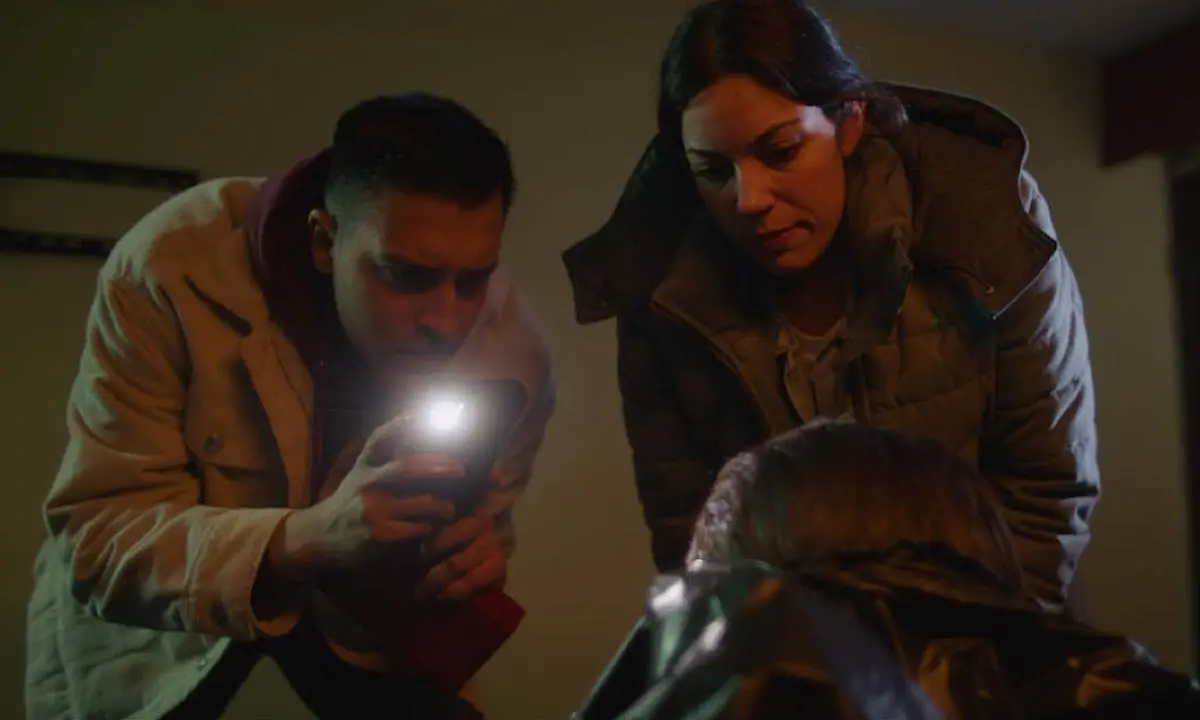
MPX presents I Know Exactly How You Die, streaming on digital platforms now.
Synopsis
When his slasher-fiction novel manifests in real life, hack writer Rian Burman has to finish his story without getting his protagonist murdered by a seriously sadistic Stalker who will stop at nothing to have her.
Review
Whether fairly or not, contemporary audiences will often hear the synopsis of a new horror film and impulsively blurt out “Ohh, kind of like that Stephen King novel!”
It’s become so ritualised to recognise King-adjacent ideas in horror media that anything even resembling something from his bibliography is instantly crammed into that makeshift genre.
In the case of indie stalker-horror I Know Exactly How You Die, the key feature that sits it firmly at the ‘Stephen King Table of Tropes’ is the inclusion of one of King’s favourite archetypes: the author protagonist.
The saying goes “Write what you know”, and King clearly took that to heart, pumping out enough books and short stories with authors in the lead role that they’re now well into double-figures.
But this trope has become a classic for a reason. Writers are often interesting subjects, coming pre-equipped with their own hangups and internal conflicts. Writers’ block, inflated ego and the type of insecurity only found in aspiring creatives can clear the way for a great, psychologically complex story.
I Know Exactly How You Die strikes me as a film that, at its heart, understands the universal appeal of those internal conflicts, and clearly has something interesting and quite powerful to say about trauma, ego and the nature of romantic obsession.
While many slashers of a similar budget (that is to say, very, very low), would rely purely on splatter-horror and cheap jump scares, director Alexandra Spieth aims for something a little more cerebral than that with her second feature – though not foregoing gore altogether, it should be stressed.
The film is about a “hack” horror writer called Rian, who stops at a motel following a breakup to write a new slasher novel at the demand of his increasingly irritated publisher. But as Rian starts to write about a woman fleeing her stalker, he is shocked to discover his protagonist – bearing a striking resemblance to his ex – has come to life, and is staying at the same motel.
In the first five minutes we get a taste of what will become the film’s biggest issue: overacting. Our two leads, Rian and Katie – played by Rushabh Patel and Stephanie Gomes Hogan, respectively – are the main culprits of this, each bringing an immediate intensity to their role which left them little room to get much more intense even as the story did.
Patel brings a kind of sugar-rush absurdity to the role of this writer, which was presumably an attempt at making the character seem scatterbrained and quirky, but ended up just draining the early comedic moments of any subtlety.
Gomes has a similar problem. Though having a stalker would undoubtedly be a very intense experience, Katie so frequently emits an aura of barely restrained fury from her eyes that I thought she might melt the set with heat vision.
These performances lead to some unintentionally funny moments, like Rian listening to a bitter screaming match between a couple next door and calling, gawkishly, “Is everything alright in there?”, or Katie describing her stalker “sending [her] other people’s packages” with a burning ferocity usually reserved for far worse offences than simple mail interference.
These off-kilter performances, left unchecked by Spieth, make it almost impossible for any tense atmosphere to effectively build across the opening of the film. Was I enjoying myself? Sure. Was it for the reasons the creators intended? Probably not.
The sound design and score didn’t help on this front either, seemingly created for the sole purpose of either completely obliterating tension, or generating an otherworldly atmosphere to replicate that of Twin Peaks and other oddball classics.
But unlike in Twin Peaks, this didn’t feel intentional and practiced, but rather the result of sloppy tone management. Goofy, staccato sound effects ring out when something is supposed to shock you. Awkward, lumbering music plays at moments of intended whimsy, instead sounding silly and abrasive.
But the film isn’t completely devoid of subtlety or, thankfully, meaning. The owner of the motel, Naja – played by Rawya El Chab – delivers a performance that is often refreshingly understated. At one point, Naja has a heart-to-heart with Katie, relating to her through her own experiences with violent men.
It was here that it became apparent to me that I Know Exactly How You Die actually had something serious to say, and I was glad to see some nice nuggets of dialogue and earnest acting squirrelled away in a film that was otherwise a bit all over the place.
As we get into the meat and potatoes of the main premise, we run into the second biggest problem of the film: it’s just not that scary. This is largely due to one of the key elements of the plot, which is that Rian is, for the most part, entirely in control of the events unfolding at the motel.
Because anything Rian writes is sure to come to pass, he is never really in any danger, other than at the times the script arbitrarily decides that he is. Because the rules of the paranormal phenomenon are never effectively established, it’s impossible to get a good idea of what the stakes actually are.
Perhaps the intention wasn’t for the audience to be scared for Rian, but rather for the people caught up in his story.
This felt like a key component of the film and, to the writer and director’s credit, it’s a very interesting idea. There are, at times, parallels drawn between the imagined stalker and Rian himself, and I found myself considering how stalkers are essentially the authors of their own twisted fantasies.
The fact an ultra-low budget slasher film was able to convey this idea in a way that made me physically imitate the Thinker statue was a pleasant surprise, and deserves to be praised.
However, whether we were meant to be afraid for Rian, his victims, or all of the above, we’re simply not scared for anybody, at any point. Camerawork is pedestrian and uninspired, with the cinematographer making poor use of the spaces the crew had available to generate any real scares.
We see no creative use of negative space and the lighting is frequently flat. There are a handful of interesting nightmare sequences, and some practical effects that clearly had some love put into them, but they don’t contribute to the horror the way a carefully storyboarded stalking scene would.
The best we get in that regard is the stalker attempting to open a locked door, and that hardly gives the cinematographer a lot to chew on creatively.
Despite the lameness of a lot if it, there really is some meaning at the core of it all. We get an examination of how women are very often caught up in the dark fantasies of egomaniacal men, and left at the mercy of their delusions. This idea is committed to wholeheartedly, and I give huge props for that.
Verdict
Though much of the film is about as scary as a girl scout selling cookies door-to-door (and at least that could startle you), I Know Exactly How You Die makes a compelling statement about how fantasy can quickly turn to exploitation – albeit, a statement rendered mostly inert by its goofy delivery.
⭐⭐
