

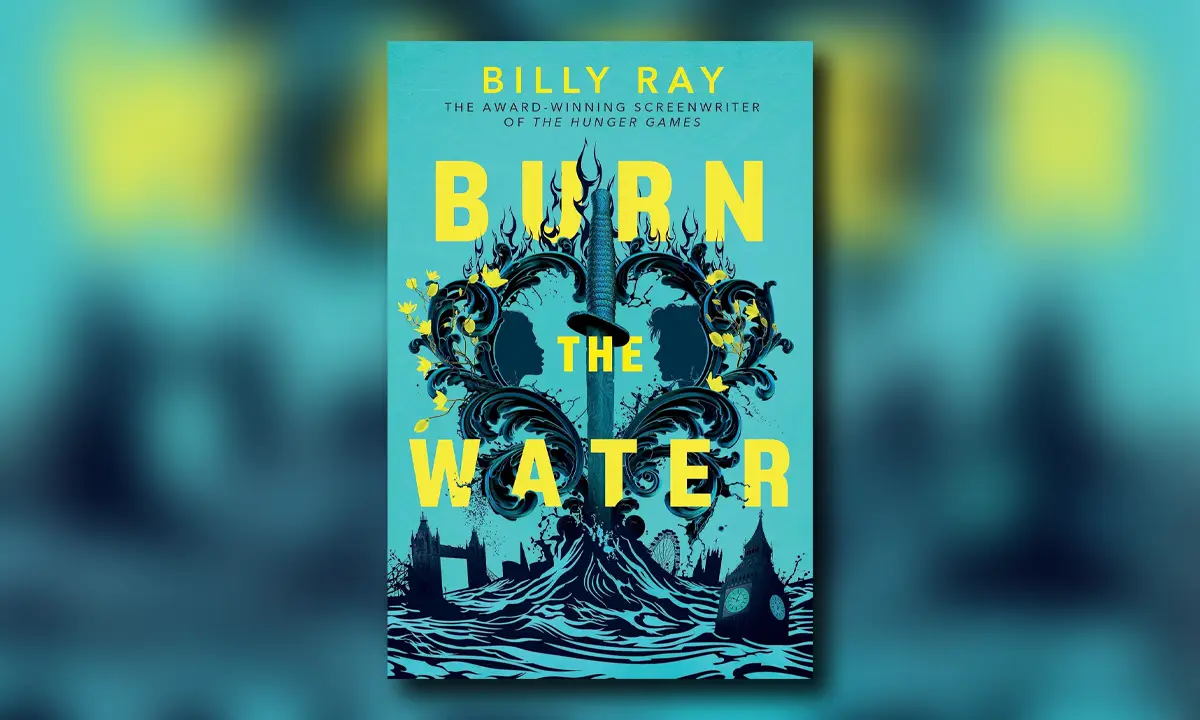
Burn The Water is written by Billy Ray and published by Scholastic. The book is available to pre-order now– and will be released on March 12, 2026.
Synopsis
From the experienced hands of Oscar-nominated screenwriter Billy Ray a tale of bloodshed spills forth… And, with the ghosts of Romeo and Juliet close by.
Burn The Water, set in 2425, sees a London submerged – both by oceanic waters and the tumultuous seas of violence. After the devastating consequences of global warming, London’s people are divided into two houses: The Crowns, led by their fearsome soldier Jule, and The Rogues, spearheaded by their captain Rafe. Separated by centuries of grief and turmoil, each House draws blood, sweat and tears from the other. But, their rivalry has never been touched by love… until now.
As Rafe and Jule fall for one another, they wage a private battle to keep the other alive – alongside the kindling of a burning, passionate love. But, when London is put under pressure by a mysterious invader, The Rogues and Crowns may just tear each other apart.
Will Rafe and Jule find a way to save their warring factions, and keep their love – and lives – intact?
Review
Billy Ray is no stranger to dystopia – he was the screenwriter of the original Hunger Games, as well as its upcoming prequel, Sunrise on The Reaping. He has written about bone-breaking battles, characters with the gift of rebellion and tender, heartfelt exchanges; he has shown his hand and dealt cards of a powerful variety. And, in his debut novel, Rafe and Jule stand as high as Peeta and Katniss ever could.
Burn The Water is resoundingly passionate in every way; as a love story, as a call to arms, as a warning over environmentalism, Ray’s emotion is the novel’s most engaging feature. It is easy to connect to him through his words, which feel tried, tested and true. Every ripple of the murky river, every cry of a terrified child, every embrace between Rafe and Jule – it feels lived in and honest. It is all described with simplicity – and there is a certain power in this.
One of Ray’s chief messages in this book echoes to his younger readers: your time is now. His exploration of themes such as taking courage in disheartening times, is Ray’s biggest act of rebellion. Known for his political advocacy, his deep-seated morality is almost tangible within his words. It is a necessary reminder for adolescents and young adults in these trying times – that they have a voice to use, no matter who they are.
Just as important is Ray’s message of appreciation over the immaterial. He wastes no time describing the waterlogged city, which has rendered skyscrapers and electronic communication useless. All the characters have are seaweed, dirt – and emotion. In a moment reminiscent of the Mozart sequence in The Shawshank Redemption (1994), a small group of troubled Londoners listen to old vinyl records. Dizzying classics spin out amongst the group, signifying a deep moment of gratitude. It is these moments where Ray embeds a profound sense of appreciation for life itself, into his writing. And music itself will feel sweeter after reading.
Ray’s warring scenes are a tour-de-force of description. Plotting out and unfolding within your mind, they spin out like a showreel. He does not shy away from depictions of bruised limbs, broken bones – and devastating loss. Whilst many will touch on the novel’s romantic edge, the scenes focused on parent and child have a shocking impact. Every severing of these familial bonds, every long-awaited reunion – it all succeeds with undeniable realism. In a world where families are being cruelly torn apart each day, his words cut deep – and stay with you.
The fervour of Ray’s battle sequences are undercut by another kind of adrenaline – the bubbly tonic of romance. Ray manages to make their romance whipped-cream light – yet, in the war’s headiest moments, it feels as grounded within you as bone. Whilst all readers will have a familiarity with the legendary Romeo and Juliet story, Ray dismantles these pillars to build them anew. Rather than tragic damsel and angsty knight, Rafe and Jule are equals, with Jule often appearing the more dominant of the two. The poetics of Ray’s writing are tenderly effective, appealing to our sentimentality with descriptions of quiet affection. In a market flooded by the enemies-to-lovers trope, Ray sets a new precedent: that opposers can love, with a poetic decadence, as opposed to a violent, vitriolic love.
Verdict
Burn The Water is a book of many threads – and as they weave together, they stand resolute in perfect synchronicity. It is fast-paced when it matters, with battle scenes that rip and tear and smite. And yet, it slows to a loving promenade, when it needs to touch and hold.
Billy Ray’s debut novel cements himself as a caring, tender writer, who writes with the essence of humanity in his heart. But, never for a moment does he let his sense of rebellion slip.
⭐⭐⭐⭐
