

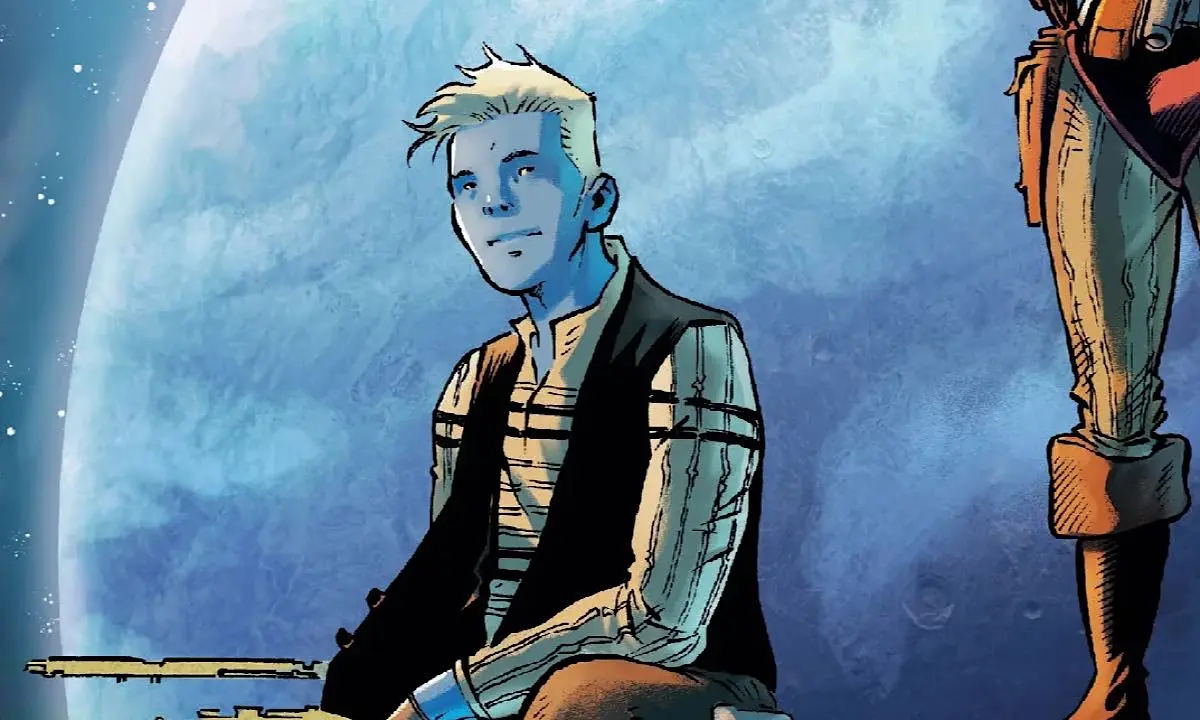

Astro Quantum #1 is written by Andrea Mutti & Arturo Fabra, and published by Mad Cave Studios. Artwork is by Andrea Mutti, colours by Valerio Alloro and letters by Dan Cutali. Main cover art (left) is by Andrea Mutti & Valerio Alloro.
Astro Quantum #1 is available from today, in comic book stores and on digital platforms where all good comic books are sold. Grab your physical copy from Forbidden Planet or digitally from Amazon Comixology UK.
Synopsis
Cast out to die on the toxic world of Maku, young Ishmaeel finds an unlikely ally in the sharp-tongued Soliumite exile Quee-Keg. Together, they claw their way through underground bazaars, brutal creatures of the Galaxy and bitter rivalries to chase a destiny bigger than either imagined: a place aboard the legendary Molok-hunting starship PEKUOD. An all-new epic space saga of survival, rebellion, and the hunger to reach beyond the stars starts here!
Review
At first glance, Astro Quantum #1 looks like it could be an exciting trip to a promising new sci-fi universe, with some vivid imagery catching the eye. But though there’s still plenty of time for the series to make good on that promise, there are a few causes for concern as early as the first few pages.
The dialogue is largely clunky and derivative. Any dramatic or humorous moments are deflated by a lack of flow and rhythm in the syntax, with punctuation in the wrong places and the boldening of words emphasising the wrong part of the sentence.

This would be okay if the characters and setting were as otherworldly as the sentence structure, but while the universe established here borrows much from other sci-fi worlds for its aesthetic and core concept, it contributes few ideas of its own for readers to latch on to. Ultimately, what should feel alien and new ends up seeming all too familiar.
As some purely light adventure, the story works well enough. In concept, Ishmaeel and Quee-Keg’s relationship is a tried-and-true match up. An idealistic – if naive – adventurer on a quest with a jaded, no-nonsense vagabond.
But the interactions between these two protagonists feel so staged and predictable that any potential for chemistry or an organic back-and-forth is lost. The clunky dialogue only exacerbates the issue, making conversations read like an extraterrestrial’s take on Firefly.
Again, we see another idea play out which, in concept, is fun, but doesn’t deliver where it ought to. Quee-Keg has a pet insect called Kibo, who she races against other insects in a sort of black market bug-racing competition, to earn money for ship parts.
But the result of this race, which I won’t spoil, doesn’t show any real skill or guile on Quee-Keg’s part. She does nothing to directly impact the outcome of the race, and so nothing meaningful is revealed about her beyond the fact that she has a pet bug.

This would have been a great opportunity to show us how sly and resourceful this grizzled outlaw of a character can be, and it’s wasted. The concept is there, but the execution isn’t.
The art is technically solid and conveys everything it needs to on the most fundamental level. We get to see a cool desert planet dotted with metal spires, and some lens flares thrown in for good measure. Establishing images of space cruisers tucked away in asteroid fields or shuttles approaching vibrantly coloured planets all look lovely, but the art direction itself is what’s missing
Our main character, Ishmaeel, looks like a throwaway extra from a Star Trek episode, his defining visual characteristic being that he’s blue. Quee-Keg doesn’t fare much better, with some interesting tiger stripes on her arm, but otherwise just looking vaguely Romulan-esque.
Even the miscellaneous alien thugs in the Mos Eisley-adjacent Nuube bazaar are all just slight variations on a generic humanoid hoodlum.
With artist Andrea Mutti also being the top-credited writer of this project, it’s easy to imagine a scenario where they maybe wanted to get a passion project off the ground, and took on the main bulk of writing responsibilities to streamline this, despite being an artist first and a writer second.
But I can’t imagine anyone being passionate about drawing these characters, either. The passion certainly doesn’t appear to be going into drawing the environments, because aside from the pretty establishing images, the backdrop to most panels are often dust clouds and sparsely detailed buildings.
The one main fight scene of the issue, a fisticuffs in a bazaar, is satisfying to look at, for sure. Mutti illustrates the velocity behind a punch and a kick very well, and the simplicity of transitioning from the explicitly drawn violence of fist-to-face collision into a single panel of blood spatter is very effective.
This fight scene would definitely be more effective, though, without such gems of thug dialogue as “You’ve got a lot of nerve showing your face around here”, “You must die!” and, my personal favourite, “Ouch!”.
There are times when I second-guessed myself, thinking maybe the stilted dialogue was intended to emulate old Saturday-morning cartoons. But the style Mutti and Fabra are shooting for here is very clearly a gritty space-western. Something to be taken somewhat seriously.
So having characters flat-out say exactly what they’re thinking all the time, rather than having it suggested through subtext, really undercuts this aim. Not to mention seeing a space gangster actually say “Ouch!” as a genuine reaction to being socked in the chin.
Verdict
It’s hard to recommend Astro Quantum #1 to even the most die-hard fan of the genre. While it’s possible the series will improve, problems inherent in an author’s writing style typically stick around for the long haul. But if you just want to see alien thugs get a good kicking, this book has it all.
⭐⭐
We are a participant in the Amazon Services LLC Associates Program. This affiliate advertising program also provides a means to earn fees by linking to Amazon.com and affiliated sites. We are also members of the Forbidden Planet Affiliate Program.
