

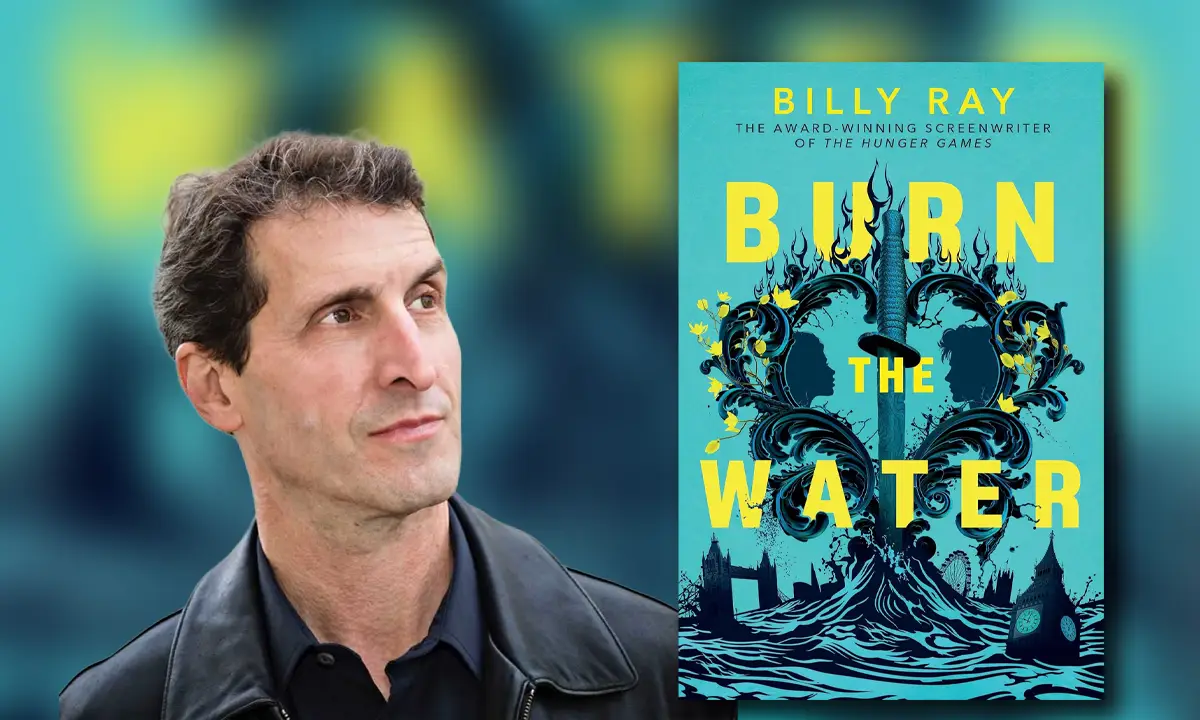
Fans of The Hunger Games have waited for the fateful Haymitch’s story to grace the silver screen for years. His stoic yet quietly caring nature has cemented him as one of the franchise’s most beloved characters – and screenwriter Billy Ray was tasked with bringing his games to their fullest glory.
In this interview, Bella sat down to talk with Billy, whose debut novel Burn The Water is available in stores now. In this interview, Billy offers an early insight into what fans can expect from the latest Hunger Games instalment. He also offers some generous advice for young writers looking to break into the industry. You can watch and read our full conversation below:
Bella (GYCO): So, we’ve got to talk about The Hunger Games! I know you’ve written the screenplay for the upcoming Hunger Games film, Sunrise On The Reaping. And you wrote the original screenplay for the first film.
I know you probably can’t give us a lot of details. But I was wondering what the writing process was like.
Billy Ray (BR): It was unlike any process I had ever had before, because when I came aboard, the book was not yet published.
This was July or August, of ‘24. The book hadn’t been published yet, and everybody was hysterical about security. No one could know anything in that book. So, the first time I was allowed to read it, I went to the home of Suzanne Collins’s manager, and I literally sat on his living room couch with a printed copy of the book, and I read it for seven hours, and then I gave it back to him. And I said, ‘Okay, I’m in, let’s go.’
And then we started the conversations about what the book is about. And, Suzanne, as you can imagine, cares deeply about the politics and the philosophy of The Hunger Games. So, it was long hours with long conversations about implicit submission and the importance of propaganda and the philosophy of Locke and Hume – she’s so well read, and she feels it so deeply.
And then at the end of that, I said to her, ‘Okay, Suzanne, on an emotional level, what’s the book about for you?’ And she said, love and loss. I said, ‘Okay, that’s what I’m going to go write.’
And the process of writing was also very different because of the security. They wouldn’t allow me to write on a computer that was connected to the internet. So, I could never have the book on my own computer. Every day I got up and I go to 20th Century Fox, I would walk into this tiny office and an assistant would walk in with me and would open a safe on the floor and pull out a laptop and open it for me. And I would write. And then when I was done, she’d come in, close up the laptop, put it in the safe, lock it, and I would leave!
And that’s how it went until the thing was written. There was never a point where I was rolling out of bed, thinking ‘Here’s an idea!” and emailing it to somebody like that, that just doesn’t happen on a Hunger Games movie. And, it was that way until the book was published. Once the book was published, the security got a touch looser. But it never, ever was a normal process.
Bella: Did you find that that restricted your creativity in any way? Because I can’t imagine, as a writer, having to go to a specific place, do it for a set amount of time, and then then leave.
BR: I’ve been very lucky in my career – so far, I can write anywhere. I can write on planes, trains, in the trunk of a car, I can write in hotels in Prague – it just doesn’t matter to me.
I always had a notepad by the bed, and if I woke up three in the morning and there was an idea, instead of going downstairs and writing it, I would just make notes. And then went into the office in the morning. It didn’t restrict me in any way, and what it did was keep reminding me what a big deal this was, how much it to the fans of the franchise, how much it meant to Suzanne. I kind of liked the rigidity of it, it made me feel more important.
Bella: Yeah, I can imagine. I think that’s impressive because I know a lot of writers – and as a writer myself – creativity is obviously the most important thing, but being in the right headspace and the right place to write is important too.
BR: I’m from a very, very different generation than yours. And, I don’t believe in that headspace stuff. It’s just like I don’t believe in writer’s block! If you think of yourself as an artist, it’s really easy to get caught up in that and not be able to write. If you think of yourself as a mechanic and if you just think of it as work – don’t think of it as art – and you’re going into the garage every day, and you’re just opening the hood and making the engine run better, it takes a lot of pressure off of you. It makes you a little less precious, both with yourself and with your work.
And at the end of the day, if you’ve treated it like work and not art, you can look at yourself in the mirror and say that ‘I did my job today.’ As the great writer Paddy Chayefsky would say, ‘If you’re an artist, it’ll come out as art anyway.’ So take that pressure off yourself and just get used to writing anyway.
But the truth, Bella, is that your talent travels with you. Your talent doesn’t only exist in one room, or one time of day, or with one kind of music on. Your talent is you, and you have to learn how to master it, and think in terms of craft you can do anywhere.
Bella: Is that the main piece of advice you’d give to young writers, whether it’s just someone who wants to be a novel writer or a screenwriter?
BR: When I was 23, I was desperate to become a screenwriter. But I was working a full time job. So, the only time I could write was on Sundays. Literally, every Sunday and every Sunday night. And then, something clicked in my head as I was staring at the wall – back when there were typewriters, to give you the full context.
What clicked in my head was, I am not more talented than the people I’m competing with. So, my only remedy is to outwork them. I just have to out-hustle them, that’s it. And I started on that day, on that path. And I work harder now at 62 than I did at 22. And I worked hard at 22.
Never let anybody out hustle you never let anybody outwork you, ever. I go to meetings with people that I’ve known for 30 years and pretend they’re an audition. I literally pretend I’ve never met these people before. And it’s a chance to make a first impression on them every time I talk to them. And that impression is, ‘Hey, I’m going to work really hard for you, and I’m going to be collegial, and I’m going to be open to notes, and I’m going to leave my ego outside the door. And I’m going to do 60 drafts if you need it.’
The great movie Amadeus, which is number eight all time on my list – it was a 46th draft. Peter Shaffer said, ‘This is as good as I can get it.’ And 45 times someone said, ‘Peter, I have notes.’ Well, if it took Peter Shaffer 46 drafts, it’s okay if it takes me ten or fifteen or twenty. That’s just how hard writing is. And once you embrace that, it stops shocking you and it just starts what is actually most gratifying about the work.
Bella: That’s really helpful advice – and I’m sure a lot of people will appreciate that.
And to bring it back to The Hunger Games for one more question – I know you can probably tell us so little facts, but I was wondering what fans can expect from this film.
BR: Well, weirdly, the whole thing’s a musical this time.
Bella: Oh, really?
BR: I’m kidding! What you can expect is, I think, the best of the Hunger Games films, so far. I love the story. You know Francis Lawrence, you know how he directs – he’s brilliant. He has cast it spectacularly. I think it is about those things that Hunger Games fans thirst for – no pun intended – and it delivers on that. So I’m really, really excited about it.
Bella: t’s it’s going to be huge. I already know so many people who are super excited for Haymitch’s story to come to the big screen
BR: Gotta buy your tickets now, it hits theatres in November!
Bella: The hype is already starting now. It’s going to be crazy by November.
BR: And I’m so proud to be a part of it. The first time I was ever offered the Hunger Games – the first one – I had never heard of it. And my agent called me and said, ‘Okay, do you want to do The Hunger Games?’ And I literally walked into my living room – my daughter was 14, my son was nine – And I said, What’s the Hunger Games?’
And I read the book. I said, ‘Oh, this is the greatest idea I’ve ever heard.’ It’s just the darkest idea I’ve ever heard. And it has been such a blessing in my life to be a part of this franchise, to have helped to launch it, and to now be telling this chapter. It has been so great for me and to me – and really I’m thrilled to help birth this one as well.
Bella: It must be a huge, huge privilege. They are such an important experience for a lot of teenagers and a lot of people like me in their early 20s who’ve grown up reading those books.
BR: I hope that I’ve earned a little bit of loyalty, with this fan base. And I hope they will investigate Burn The Water, which goes on the stands March 3rd! You can preorder it now, it means so much to me, I’ve never done this before.
This is my first published novel and, my God, to be in the realm of The Hunger Games would be the dream of dreams. And it will rise and fall with the fans of The Hunger Games, they will be the first audience, I think, that will sample this book. And all I can say is thank you.
Bella: The book is absolutely worth the read, and I’m sure it will inspire a lot of younger teens and older teens because it is a tale that is needed right now. And a lot of people need to hear it. Thank you so much for your time!
